
The Center of the Universe

St Croix, United States Virgin Islands

MOSLER'S LAW: There is no financial crisis so deep that a sufficiently large tax cut or spending increase cannot deal with it.

US Consumption and Tax Policy

Posted by WARREN MOSLER on August 12th, 2009


[Skip to the end]

Some interesting bits.

Supports my contention that we are seeing real wealth flowing upward and will continue to do so.

Note the distribution of consumption, which has been moving north as well.

Proposed tax policy won’t change any of this- higher incomes will more than offset increased marginal tax rates for the top tax brackets, and consumption will increase.

And yes, an economy can work via aggregate demand coming predominately from the top, with the bottom at subsistence levels. And we are moving in that direction.

Interestingly, as this happens the wealthy are considered ‘good’ when they hire hundreds of service people to take care of their homes, boats, personal fitness, and entertaining, etc. as they are ‘providing jobs.’

This also fits well with the export economy model our leaders are pushing hard to achieve. And the trade numbers are looking like they are succeeding. Notice the trade gap narrowing as standards of living fall.

Interesting research from ML-BAS highlighting the importance of the tax policy debate for US consumption growth and consequently US GDP:

US Consumption (Currently 72% of GDP)

  • Outlook for consumption depends on consumer outlook—on disposable income, wealth, and credit quality.
  • Wealthy (top 10% of earners) have a surprisingly high share of consumption (42%) with the middle class (40-90 percentile) composing 46% of consumption.
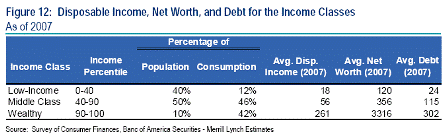
The US consumer as a whole is not overleveraged—the middle class is.

  • 200% debt to income and 25% debt to assets ratios are substantially higher than the wealthy’s corresponding ratios of approx. 120% and 8% respectively.

Housing wealth has a bigger impact on consumption than stock market wealth.

Wealthy have weathered the last two years a lot better than the middle class:

  • Retained employment much better.
  • Suffered lower wealth losses
  • Substantially less proportion of assets in housing.

Conclusions:

  • Overleveraged middle class burdened by real estate losses will not help consumption rebound.
  • Lower income segment has a relatively small proportion of income, suffers from a disproportionate share of unemployment which lags GDP out of a recession.
  • Wealthy –with modest leverage, near full employment, and experiencing a faster rebound in their wealth should lead consumption if all else stays the same.
  • However, reliance on government borrowing has increased as a result of addressing the credit crisis as well as the potentially ambitious health care reform bill.
  • Rising taxes (especially the “soak the rich” policies that are on the table) may offset potential consumption growth as the most important determinant of consumption is after tax income.
  • The outlook for tax policy on the top earners may provide a key swing factor to the consumption outlook.


[top]

4 Responses to “US Consumption and Tax Policy”

  1. Mike S Says:

    Incredible statistics. I bet if these had been broken out so the top 1% was a group to itself, the debt to income of the 90 to 99 % range would more closely match the middle class than the top 1%.

    Reply

  2. Dissenting Comments Encouraged Says:

    Many US colleges and universities have notices posted on their websites informing US companies that they’re tax chumps if they hire students who are US citizens. ‘In fact, a company may save money by hiring international students because the majority of them are exempt from Social Security (FICA) and Medicare tax requirements,’ advises the taxpayer-supported University of Pittsburgh (pdf) as it makes the case against hiring its own US students. You’ll find identical pitches made by the University of Delaware, the University of Cincinnati, Kansas State University, the University of Southern California, the University of Wisconsin, Iowa State University, and other public colleges and universities. The same message is also echoed by private schools, such as John Hopkins University, Brown University, Rollins College and Loyola University Chicago.”

    http://news.slashdot.org/story/09/08/13/137252/US-Colleges-Say-Hiring-US-Students-a-Bad-Deal

    LOL! Warren, like kurt russel from that movie USED CARS, USA princess is too phucking high!!

    Reply

  3. Dave Begotka Says:

    Dudes, from my view, the employment numbers are right out of LALA land!

    Nobody I know is getting anywhere and most are going into the crapper, a lot of teachers, industrial workers, and most government workers.

    Small business is stagnant, and even this web page is getting dull.

    Except Dysentery he is trying even harder to push his vulgarity.

    Maybe you all need to watch my new videos

    Reply

  4. Dissenting Comments Encouraged Says:

    Begotka, I am not pushing anything, I am just a mere reflection of the society I have grown up in. With all it’s corruption, superficiality, and short sighted liquidity fetish stupidity!

    http://news.slashdot.org/story/09/08/13/195235/18M-Contract-For-Transparency-Website-Released-mdash-But-Blacked-Out

    “The US government recently approved an $18 million contract for Smartronix to build a website where taxpayers could easily track billions in federal stimulus money, as part of President Obama’s promise to make government more transparent through the Internet. However, the contract, which was released only through repeated Freedom of Information Act requests, is itself heavily blacked out. ProPublica reports: ‘After weeks of prodding by ProPublica and other organizations, the Government Services Agency released copies of the contract and related documents that are so heavily blacked out they are virtually worthless. In all, 25 pages of a 59-page technical proposal — the main document in the package — were redacted completely. Of the remaining pages, 14 had half or more of their content blacked out.’ Sections that were heavily or entirely redacted dealt with subjects such as site navigation, user experience, and everything in the pricing table. The entire contract, in all its blacked-out glory, is here.”

    Reply

Leave a Reply

XHTML: You can use these tags: <a href="" title=""> <abbr title=""> <acronym title=""> <b> <blockquote cite=""> <cite> <code> <del datetime=""> <em> <i> <q cite=""> <strike> <strong>