The Center of the Universe

St Croix, United States Virgin Islands

MOSLER'S LAW: There is no financial crisis so deep that a sufficiently large tax cut or spending increase cannot deal with it.

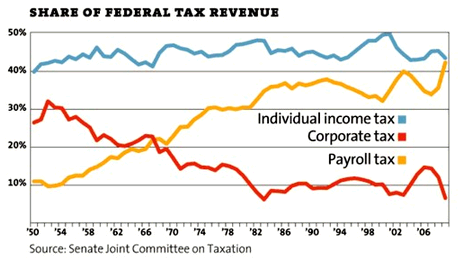
FICA taxes share of Federal tax ‘revenues’

Posted by WARREN MOSLER on August 27th, 2012

37 Responses to “FICA taxes share of Federal tax ‘revenues’”

  1. Greg Marquez Says:

    My mom and I were just talking about that. She was remembering that for the longest time the total employee/employer contribution was like 6% on a maximum of like $8,000. All that changed in the 80s when we had to balance budget. So now we have 16% on total of $200,000?

    Our discussion was really about growth in income disparity. It seems like the tax on the poor doubled while the tax on the rich actually went down. It became a lot more expensive for employers to hire people. Employers started substituting non-taxable benefits, like healthcare to avoid the payroll tax. Health insurance costs naturally began to skyrocket as demand for health insurance increased.

    My real question though is what should the return be on 16% of income taken out every year for fourty years? Seems like that should make for a pretty good retirement, no?

    Reply

    vincent Reply:

    @Greg Marquez,
    I think HC benefits go back to the time of Roosevelt as a workaround wage controls.
    The cost of healthcare has more to do with the high cost of new technology and medications, as well as MDs difficulty to cost contain in the current tort environment.

    Reply

  2. Roger Says:

    And I was just starting to beleive that most Americans pay no taxes………

    Reply

    WARREN MOSLER Reply:

    all people who work and report their incomes pay FICA

    Reply

    Roger Reply:

    @WARREN MOSLER,

    Sorry, I was being sarcastic against the false claim that a majority of Americans pay no taxes.

    Reply

  3. Larry Kehoe Says:

    FICA is really a premium for retirement/ disability insurance. They just made it a tax to make it constitutional.

    Reply

    chewitup Reply:

    @Larry Kehoe,
    Except the government doesn’t invest the float. It just disappears.

    Reply

    WARREN MOSLER Reply:

    so if they adjusted retirement benefits based on your ‘regular’ income taxes paid they wouldn’t be taxes either?

    like the Obamacare charges the supreme court just ruled on.
    Romney now says it is a tax but he agrees with the minority of judges who said it wasn’t constitutional because it wasn’t a tax…

    in any case, the function of taxes is to reduce aggregate demand which FICA deductions do just as much as any other deductions.

    Reply

    vincent Reply:

    @WARREN MOSLER,
    Warren, the President’s law calls it a penalty. the minority on the court said they on the court couldn’t re-invent the law, not that it weren’t essentially a tax.

    Reply

    WARREN MOSLER Reply:

    i thought the majority said it fell under taxing authority?

    ESM Reply:

    @vincent,

    Actually, only one justice thought it was a tax. The other four in the majority dishonestly agreed it was a tax in order to get the result they wanted.

    vincent Reply:

    @vincent,

    the minority said a penalty, as is was termed in the law itself, was unconstitutional. the administration argued, at the time the law was passed, that it was not a tax, and that’s how the law reads.

  4. chuck martel Says:

    The graph illustrates relative share, not actual numbers. Corporate taxes could have gone up in real terms, but decreased relative to income tax and payroll tax. But none of it matters because the money is created for tax payment purposes.

    Reply

  5. Dan Lynch Says:

    FDR deliberately sold SS as a prepaid insurance program, even though the insurance program framing has always been a bit of a white lie.

    In those days people were very reluctant to participate in government “welfare” programs. Calling it “insurance” helped remove the stigma.

    The other issue was that by making people feel like they had earned SS by paying into it, voters would then resist any attempt to end the program.

    FDR said, “I guess you’re right on the economics. They are politics all the way through. We put those pay roll contributions there so as to give the contributors a legal, moral, and political right to collect their pensions and their unemployment benefits. With those taxes in there, no damn politician can ever scrap my social security program. Those taxes aren’t a matter of economics, they’re straight politics.”

    http://www.ssa.gov/history/Gulick.html

    But I agree with Warren that FICA is bad economics. And I have a selfish reason for dropping the “insurance” facade and instead funding SS with keystrokes — I’d like very much to lower the retirement age to, say 55 — so that I can retire — and raise the benefit so that we can actually live on SS.

    Reply

    Walid M Reply:

    @Dan Lynch,

    Your dream of retiring at 55 and getting enough SS to live on ..was real life for most Greeks before 2008.

    Reply

    Neil Wilson Reply:

    @Walid M,

    No it wasn’t. Normal retirement age in Greece is 65.

    Eurostat shows the average age of Greek retirement is 61.7 years and that they work on average over 2000 hours a year – compared to the German average of 1400 hours.

    ‘Lazy Greeks’ is propaganda. Most Greeks work long hours for poor pay.

    Reply

    Walid M Reply:

    @Neil Wilson,

    The success of the lazy ‘anyone’ propaganda tells you a little about the support there is out there for Dan’s wish..a 1% own it all and a 99% welfare dependent society/economy just does not cut it for me …

    Neil Wilson Reply:

    “a 1% own it all and a 99% welfare dependent society/economy just does not cut it for me”

    That rather depends how efficient your robotic production system is doesn’t it?

    Hopefully its somewhat better than your logical reasoning. Excluded middle arguments are so uninspiring.

    Walid M Reply:

    @Neil Wilson,

    thank for your corrections Neil ..Dan was expressing a personal bias ..My bias is for more jobs, more work for longer with more income for more people …not much logic in that i guess …so
    best have robots instead

    Ed Rombach Reply:

    @Dan Lynch,

    PAUL RYAN: “Do you believe that personal retirement accounts can help us achieve solvency for the system and make those future retiree benefits more secure?”

    ALAN GREENSPAN: “Well, I wouldn’t say that the pay-as-you-go benefits are insecure, in the sense that there’s nothing to prevent the federal government from creating as much money as it wants and paying it to somebody. The question is, how do you set up a system which assures that the real assets are created which those benefits are employed to purchase.”

    Personally I’d like to see a tax rate of 10% apply to all forms of income including earned income, interest income, dividends, capital gains, corporate tax and the social security tax, with 5% paid by the employee and 5% paid by the employer. Moreover, the income ceiling applicable to the SS tax should be eliminated and the system should be recognized as a welfare program and also be means tested. Like with the flat tax, most itemized deductions would be eliminated although the mortgage interest deduction would not be completely eliminated. Income earners would be granted a generous standard deduction such that a family of four earning $50K would not have to pay any income tax. If you do the math, you will see that the highest effective tax rate anyone would have to pay…. regardless of how they earned their money, would never be more than 15%.

    Reply

    Tom Hickey Reply:

    @Ed Rombach,

    Focusing on tax rate ignores the primary function of taxation as an inflation control device, and secondarily as a negative behavioral incentive. Taxes are not needed to fund the federal government under the present monetary system, so why not have a sliding federal tax rate that functions cyclically like automatic stabilization, as beowulf has proposed?

    There are a lot of ways that taxation can be applied with different results. Better to integrate the inflation control function with the negative incentive function to achieve a more optimal social solution than taxing productive contribution.

    Reply

    Ed Rombach Reply:

    @Tom Hickey,

    Yes, I know that the function of taxes in the MMT paradigm is to regulate aggregate demand. Problem is that it may take 100 years or more to make the public aware of that. Consequently I prefer to follow the KISS formula (KEEP IT SIMPLE STUPID). As a small government MMT/Libertarian hybrid kind of guy, if the economy was becoming overheated, and inflationary I would rather see some type of across the board cut in government spending rather that an increase in taxes.

    Brian Reply:

    @Tom Hickey,

    “so why not have a sliding federal tax rate that functions cyclically like automatic stabilization, as beowulf has proposed?”

    The real political challenge will be to convince an electorate to pay a tax that doesn’t fund anything. I’m not sure how one goes about that.

    John McDonough Reply:

    @Tom Hickey,

    In addition varying the tax rate monthly or quarterly to achieve inflation control would be a can of worms for those taxed. Talk about ‘uncertainty’!

    And there would be lags getting tax bills through Congress on that kind of schedule which would give probable positive feedback to the economy making the Fed’s job even more difficult.

    WARREN MOSLER Reply:

    took the liberty to post this again. thanks for the reminder!

    Reply

    WARREN MOSLER Reply:

    It was called a ‘useful fiction’
    not so useful anymore

    Reply

    MRW Reply:

    @WARREN MOSLER,

    I heard you use the expression ‘useful fiction’ many times in your talks. Where does the expression come from? Who actually said it?

    Reply

    WARREN MOSLER Reply:

    i recall reading discussions from the 1930′s using that term. but don’t have specific references handy

    Ed Rombach Reply:

    @Dan Lynch,

    One problem with Social Security over the years has been that they change the goal posts from time to time. Kind of like a default on a bond.

    Reply

    vincent Reply:

    @Dan Lynch,
    chalk up another for the law of unintended consequences. i guess we can blame roosevelt ultimately for this terrible regressive tax.

    Reply

  6. Paul Palmer Says:

    To me this chart explains a lot.

    In the 50′s, only about 10% of the federal govt.’s “take” was through regressive SS taxes. Now that number is up to 40%. Why labor feels poorer. And I don’t think SS was anywhere near as regressive as it is now, and personal taxes were far more progressive than they are now.

    Corporate income is probably the same contributor to GDP then as it is now, but it sure is taxed a lot less now. Thus those whose livelihoods are attached to corporate income – executives, corporate lawyers and accountants, and most of all, private equity, who have managed to make their incomes taxed as if they are capital gains.

    Also the numbers don’t add to 100%. For completeness it would be good to see where the remaining 10% or so comes from, which I believe is excise taxes, fees, etc.

    Reply

    Paul Palmer Reply:

    @Paul Palmer,
    I meant to say those whose livelihoods are attached to corporate income are faring far better than those whose livelihoods are not, relatively.

    Reply

  7. SteveJ Says:

    OK I’m not an economist and pretty new to MMT, but I don’t understand lumping the payroll tax in with income and corporate and comparing their % contribution to all federal taxes collected. At least in theory, aren’t payroll taxes going into the SS fund for current and future benefits whereas personal income and corporate taxes fund other government expenditures?

    Reply

    WARREN MOSLER Reply:

    yes, but that doesn’t make it any less of a tax. it comes out of your paycheck whether you like it or not and reduces your spending power.

    Reply

  8. Djp Says:

    What year is the last year on this chart?
    Looks like it’s 2010, or perhaps 2009.

    I was surprised to find out that 2011 was so different, but apparently it was:
    http://www.heritage.org/federalbudget/federal-revenue-sources
    They list Individual tax as 47.4% and payroll taxes as 35.6%. And, of course, the Payroll part should rightly be reduced by EITC – but I’ll grant that the correction isn’t huge (about $50B out of the $820B), but it also isn’t completely insignificant. After all, EITC was started as a way to reduce the payroll tax burden for lower income earners.

    I notice there’s no commentary on the graph. So what would have the commentary been, and how would it have changed if the numbers had been the 2011 data instead of the 2010 or 2009 data?

    Reply

    WARREN MOSLER Reply:

    don’t forget fica taxes were cut which was what i was pushing back then

    point remains lower income workers do pay a lot of at least what i call a tax

    Reply

    Djp Reply:

    @WARREN MOSLER,

    But that could be true even if the payroll tax only accounted for 10% of revenues.

    So the chart doesn’t matter?
    ok

    Reply

Leave a Reply

XHTML: You can use these tags: <a href="" title=""> <abbr title=""> <acronym title=""> <b> <blockquote cite=""> <cite> <code> <del datetime=""> <em> <i> <q cite=""> <strike> <strong>