Posted by WARREN MOSLER on February 15th, 2011
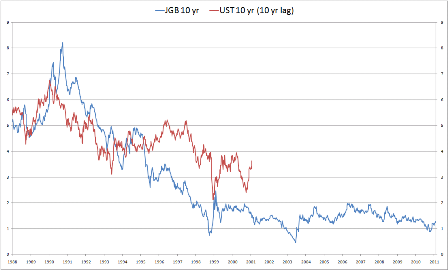
Because we believe we can be the next Greece, we continue to work to turn ourselves into the next Japan?
Japan’s surplus years were 1987-92, ours were about 10 years later from 1997 to 2001.
Both ended in stock market crashes and lower rates.

This entry was posted on Tuesday, February 15th, 2011 at 3:40 pm and is filed under Bonds, Deficit, Government Spending.
You can follow any responses to this entry through the RSS 2.0 feed.
You can leave a response, or trackback from your own site.
February 16th, 2011 at 12:32 am
Federal revenues are projected to increase by 65% over the next 4 years (http://www.financialsense.com/node/4183) from 2.2 Trillion in FY 2011 to 3.6 Trillion in FY 2015.
I agree with Dr. Martenson that on the face of it this does not seem plausible.
If the tax revenues do not grow by as much as projected over the next 4 years, then the budget deficit will remain significantly higher than projected, and the interest payments on debt will grow faster than expected. As the economy continues to recover, shouldn’t this continued deficit spending lead to increased aggregate demand and preclude a Japan-type outcome?
Reply
WARREN MOSLER Reply:
February 16th, 2011 at 7:55 pm
if revenues don’t grow it’s because the economy isn’t growing.
yes, not growing can morph into growing when the deficit gets high enough
Reply
mario Reply:
February 24th, 2011 at 2:51 am
why would the interest on the deficit effect aggregate demand in the economy? Who is the beneficiary of that type of government “spending”?
Also isn’t it possible that tax revenues can grow without economic growth? Aka a tax increase (to pay off all the debt of course…as the politicians would have us believe!!!).
cheers!
Reply
WARREN MOSLER Reply:
February 24th, 2011 at 12:35 pm
higher rates shifts income from borrowers to savers.
and the ‘non govt’ sector is a net saver, as the govt is a net payer of interest
February 16th, 2011 at 12:03 pm
UMKC back with yet another anti-Israel screed. Bill defends it by stating its about corruption (I guess suicide bombing gets a pass). When he posts links to articles he wrote about the totally corrupt PLO, I’ll believe his defense. Until then, it’s simply Israel hating and a strange obsession but typical of the left.
http://neweconomicperspectives.blogspot.com/2011/02/by-william-k.html
Reply
February 16th, 2011 at 12:37 pm
Warren,
Would be very interested in hearing your response to Kyle Bass’s position on Japan in this report, specifically pages 7-9. Much of the full report seems to miss the “sovereign currency” distinction conflating Greece and the U.S. for instance, but the Japan section (7-9) is a bit different. Your thoughts on his take would be very helpful (or of course anyone else)
http://www.zerohedge.com/article/kyle-bass-latest-must-read-letter-cognitive-dissonance-it-all
Reply
Keith Newman Reply:
February 16th, 2011 at 3:14 pm
I read the first ten pages. These guys haven’t got a clue about basic monetary operations. If you have any money invested with them, take it out now. For an explanation of their confusion go to Bill Mitchell’s blog and search for “japan”.
Reply
Jason Reply:
February 16th, 2011 at 4:37 pm
Keith,
That’s why I isolated it to the few pages specifically on Japan. I guess my question involves his claim that the annual interest alone on Japan’s debt will exceed the annual receipts of the treasury. I fully understand that from an MMT perspective this won’t't present a problem. My question is, isn’t it possible at some point this could become a psychological tipping point and lead to a big fall in the value of the Yen? If the Treasury is paying out annual interest equal to government receipts, doesn’t the huge compounding effect of the money supply eventually become an inflationary issue?
BTW, I don’t have any investments with Kyle Bass, but I suspect almost all hugely successful investors don’t understand MMT so in general it doesn’t seem to be an impediment to success as an investor. Strange but true. In fact, other than Warren I wonder how many hedge fund stars do understand MMT?
Reply
WARREN MOSLER Reply:
February 16th, 2011 at 8:00 pm
yes, deficit spending, either on interest payments or anything else, tends to make the currency ‘easier to get’ and, hence, ‘weaker’ than otherwise.
of course japan is trying its best to weaken the yen, so they shouldn’t see that possibility as a problem
February 17th, 2011 at 9:48 am
Warren,
Based on your response, then how does a country like Japan stop the runaway compounding train once it gets started? Initially Japan might like the weaker currency, but since they import so much oil for instance a dramatically weaker Yen will eventually be a problem.
Reply
WARREN MOSLER Reply:
February 17th, 2011 at 7:34 pm
when excess demand becomes a political problem the response can be higher taxes, less govt spending, or lowering private sector consumption with ‘savings schemes’
Reply
February 19th, 2011 at 8:20 pm
Ive looked at the change in some of the TIPS spreads from Nov. 15th (start of QE2) to Feb.17th:
5-yr : TIPS spread increase: 0.40% (1.57 to 1.97)
7-yr: TiPS spread increase: 0.25% (1.82 to 2.07)
10-yr: TIPS spread increase: 0.22% (2.05 to 2.27)
I wonder if this makes sense in that if there is an increase in inflation expectations due to QE (as per the monetarists) that the spread would increase more for the shorter maturities?
http://www.federalreserve.gov/releases/H15/data.htm
Resp,
Reply