Housing Rebound in U.S. Hampered by Success as Costs Soar

I still don’t see used home prices anywhere near ‘replacement cost?’

So prices have to go up quite a bit (and affordability go down) for a serious building boom to start?

Even as U.S. housing rebounds from its worst downturn since the 1930s, production bottlenecks are pushing up building-materials costs, land prices are rising and skilled labor ready to begin work is hard to find.

Housing Rebound in U.S. Hampered by Success as Costs Soar

By Shobhana Chandra & John Gittelsohn

April 24 (Bloomberg) — Even as U.S. housing rebounds from its worst downturn since the 1930s, production bottlenecks are pushing up building-materials costs, land prices are rising and skilled labor ready to begin work is hard to find.

Suppliers of glass, drywall and wood products, who reduced output during the slump, are testing the vigor of the rebound by boosting prices before committing to restore capacity. Builders, including Lennar Corp. (LEN), Toll Brothers Inc. (TOL) and KB Home, are asking homebuyers for more money as a result or are delaying sales, posing a temporary hurdle for the industry that has become one of the pillars of the economic expansion.

Building-material manufacturers are raising prices dramatically, and once theyre convinced that these prices are going to stick, theyll start reinvesting in those plants, helping ease supply constraints, said John Burns, chairman of Irvine, California-based John Burns Real Estate Consulting, which provides research to developers, construction-product manufacturers and investors. Those can take a year to get up and running.

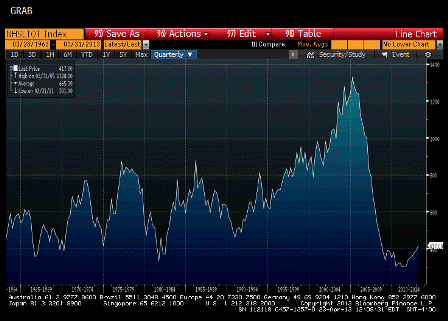
In a sign demand remains strong, a report yesterday showed sales of new houses advanced in March, capping the best quarter for the industry since 2008. Purchases of new single-family properties climbed 1.5 percent to a 417,000 annual pace, the Commerce Department said.
Low FF rate and down shift of Labor Particpation

Maybe they are beginning to confirm my ‘suspicion’ the mainstream has the rate thing backwards? Not that I agree with all their reasons, of course!

Subject: For The Economist in Us – Low FF rate and down shift of Labor Particpation

A short and interesting piece can be found on the St Louis Fed web site (and attached). Good chart on the second page showing the Federal Funds Rate and the Employment-to-Population Ratio. Towards the end of the report there is an interesting point about the current near zero rate and how it lifted, it could have have people re-enter the work force because it would increase the return to saving(s). I guess the labor force drop-outs view they’re not “leaving much on the table” . -Peter
—————————————————————————–
It is titled “Low Interest Rates Have Yet to Spur Job Growth”.

The study says that “low interest rates , of late, do not seem to be having much of the intended effect either on spending or on job growth.”

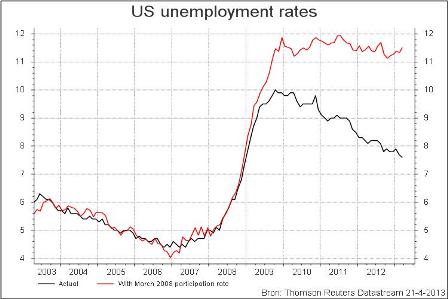
A serious concern in labor market has been the down shift of the labor participation rate which may be hiding the true level of unemployment as people drop out of the labor force.

The paper states “”Interest rates represent the return we get for waiting to consume. Low interest rates encourage more spending today, which the Fed intends, and more leisure today, which the Fed does not intend. Labor participation rates decline for many reasons, but low interest rates work in the direction of discouraging labor market participation.”

Apparently, the Fed has been chasing its own tail and the more it has lowered rates in order to produce higher demand for labor, it has generated lower participation rates.

The paper concludes, with great understatement, “After four years of low interest rates and stagnating growth around the world, a better understanding of low interest rate policies is needed.”

Maybe Chair Bernanke agrees and this explains his announced absence from Jackson Hole.

Germany’s Ifo Drops in April, Raising Odds of ECB Cut

And a rate cut only makes it worse, as per the interest income channels:

Germany’s Ifo Drops in April, Raising Odds of ECB Cut

April 24 (Bloomberg) — Germany’s Ifo index dropped in April, in a further sign that Europe’s largest economy is slowing.

The business climate reading came in at 104.4 down from 106.7 in March and expectations of 106.2.

The weak data follows Tuesday’s weaker-than-expected purchasing managers index (PMI) data.

That sparked speculation that the European Central Bank will cut interest rates at its meeting next week on Thursday.

European shares shrugged off the weak Ifo reading, in a sign the market is cheering a possible ECB rate cut.

The euro fell against the dollar after the Ifo data was released.

Thaler’s Corner 04-22-2013 2013: And now?

Again, very well stated!

Thaler’s Corner

I must admit that I am at a loss for words these days. The analytical items at our disposal describe a situation so complex, given a myriad of contradictory influences, that I find it impossible to develop any sort of reasonable scenario.


I have spent a lot of time in recent weeks exchanging ideas and perceptions with academics, political officials and others in an effort to develop a coherent explanation of the events unfolding before us (Cyprus, wealth tax, etc.), but the conclusions are anything but conclusive!

Changes in financial securities will no longer be determined by purely economic factors but more and more by political decisions, such as whether or not to establish a real European banking union with all that implies in terms of cross-border budget transfer risks.

Whatever, lets take a look at the state of the real economy in the United Sates and Europe, given that it is still a bit early to draw any sort of conclusions about a third economic motor, Japan.

By the way, I strongly recommend that people check out the links in todays Macro Geeks Corner toward the end of the newsletter. It is interesting to see how two fairly divergent schools of thinking (the two first texts) end up with rather similar conclusions.

United States

In the United States, the economy is (logically) slowing as the effects of the Sequester slowly make themselves felt. Only the (increasingly discredited) partisans of Reinhold & Rogoffs constructive austerity thought it would not affect household consumption.

We had to wait for the hike in payroll taxes for the effect to be seen in retail sales figures, down 0.4% in March. Similarly, all the latest leading economic (PMI) and confidence indicators came in below expectations, which augurs for a soft patch in the US.

Moreover, the yens decline can only have a negative impact on America trade balance with Japan as it puts US exporters at a disadvantage, in particular, as they compete with their Japanese rivals on Asian markets. And the pitiful state of the European economy is not going to help this sector of the US economy either.

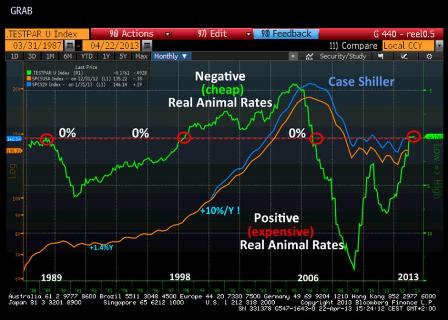
But there remains one bright spot, namely the residential real estate market, which should remain a powerful support in the quarters ahead. Check out one of my favorite graphs real animal rates.

Real animal rates in the US:


Full size image

These rates are calculated using a proprietary equation I developed, which includes, in addition to terms like mortgage interest rates, recent home price trends, the difference between the reported unemployment rate and that during periods of full employment, and the difference between the average length of unemployment and that existing in times of full employment.

With the Animal Spirits so dear to Keynes and behavioral science in mind, the goal was to factor in items more subjective than simple economic criteria (nominal borrowing rates) in the home purchase decision-making process of a household.

If experience has taught us anything, it is that the factors which most influence a potential homebuyers decision is his degree of job security and the feeling that prices can only rise.

The first point is that the only time these real animal rates dipped into negative territory (in the upper part of graph, transcribed in inverted scale) corresponds perfectly with the great real estate bubble of 1998 to 2006.

This big trend reversal occurred in 2006 when rates resurfaced above zero and thus below the graphs red line.

The only other time real animal rates became negative was in 1989, but that was abruptly reversed by the sharp hike in nominal interest rates.

In the current context, nominal interest rates are unlikely to undergo any such sharp hike in the quarters ahead, and this dip of real animal rates into negative territory should enable the real estate market to continue to recover. This all the more true, given that the yens decline will only strengthen disinflationary trends in North America, which ensure accommodative monetary policies for some time to come!

All you need to do is look at the steep decline in inflationary expectations, as expressed by the TIPS market in the US, to understand that investors seem to have finally realized that QE policies have nothing to do with the so-called dollar printing press. Notwithstanding the ZeroHedge paranoids!

That said, existing home sales in the US, out just a few minutes ago, came in weak, at -0.6% m-o-m (vs expected +0.4%, i.e. 4.92M vs 5M), which explains this afternoon shiver on stockmarket indices.

Now, as the IMF has said in recent days, the main brake on a worldwide recovery is the Eurozone, which remains paralyzed by the obsession of its northern member states on austerity and by the ECBs total and unforgivable incapacity to comply with its own mandate! In todays Macro Geeks Corner, you will find two instructive links on this matter.

Eurozone

Instead of harping on the endless stream of errors made by our beloved European monetary and governmental leaders, I prefer to comment on some far more instructive graphs.

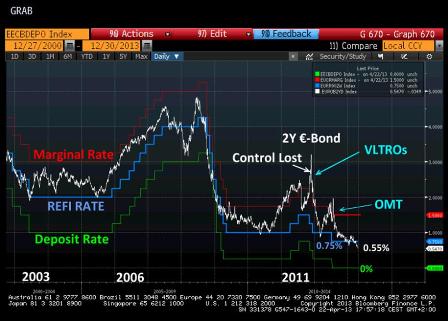
Lets start with our graph on aggregate 2-year Eurozone government bond rates, which have proven to be so useful in recent years for evaluating the ECBs reaction function.

This rate, currently at a record low 0.55%, is now well below the 0.75% set for the refi. This stems from two factors.

First, in view of the state of the economy and the latest comments by certain ECB board members, investors expect that the refi rate will very soon (May or June) be cut to 0.50%.

Second, certainty that short-term interest rates, like the Eonia, which have been stuck between 5 bps and 12 bps for the past 9 months, are not going to rise anytime soon is pushing investors to seek yields wherever they can still find them, like in Spain and Italy where 2-year bonds still fetch between 1.95% and 1.25%, now that they are assured that, henceforth, in case of insolvency, bank depositors will be forced to pay the bill without pushing sovereign issuers into default, as happened in Greece!

Aggregated Eurozone government 2-year rate:

Full size image

However, we have reason to be concerned that the ECB, if it does lower the refi to 0.50%, will be satisfied with what it already deems a low rate and highly accommodative monetary policy. Such is far from being the case, even if we go by the ECBs own obsolete aggregates, like M3, as money velocity continues to skid to a halt, following Cyprus.

And all this has an impact on the real economy, as you can see in the following graphs.

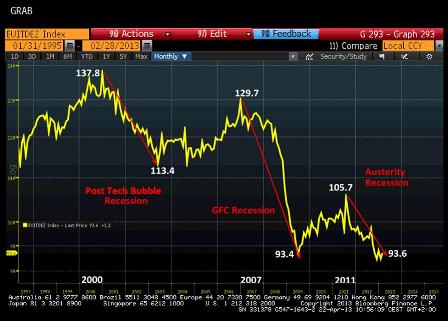
Eurozone Industrial Production

Full size image

The least we can say is that this graph is particularly distressing. Of course, it does not account for the economys industrial aspect, which some call the old economy. But it provides a whole lot of jobs and no economic area can afford to neglect it.

And the impact of Mr Sarkozys renowned Walk of Canossa, following his summons by Ms Merkel in July 2011 to Berlin where the unfortunate decision to create the first sovereign default of a developed country was endorsed (Greek PSI), is very clear on this graph. Together with a hardening of austerity policies and the nefarious consequences of the ECBs hikes of benchmark interest rates in the spring of 2011, this decision torpedoed already distressed economies, with the consequences we all know today.


But if there is one depressing economic indicator, which reflects even more cruelly how austerity affected the Eurozone, it is surely the unemployment curve.

Eurozone Unemployment

Full size image

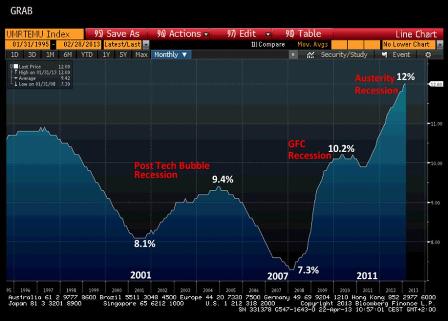
Here again, no comment is needed. I included earlier in this newsletter the graph comparing the US and Eurozone curves, but even that is no longer all that relevant. If people are happy to underperform the United States, who cares? If the Eurozone wants to try liquidationist economic policies to help drive home the morality message, it has every right to do so, just as its citizens merit the leadership they elect.

But to go from there to creating a situation of hysteria, leading to an increasingly large segment of the active population being ejected from the labor market, is a big step that must never be taken.

In some countries, the figures are just horrifying, with nearly 30% general unemployment and over 50% for those under 25 years of age. It is incredible that some continue to boast the merits of such policies for countries like Ireland while ignoring the daily siphoning of the population due to massive immigration to seek jobs elsewhere!!

I wonder if those responsible for such policies have forgotten the consequences of such an approach in Europe and the breakdown in the social fabric during the Great Depression, especially now, with so many leaders spicing their speeches with anti-German references?

This pathetic situation, reflecting month after month of economic policies based on no worthwhile or credible foundations, be it on a theoretical or empirical basis, explains why I am having a hard time re-establishing a decent pace of publication.

This is especially so in that the conflict between this depressive macro situation and the strong efforts undertaken by the Fed and the BoJ (among others) to reignite economic activity leave no space for laying out clear asset allocation biases.

We continue to enable our clients to take advantage of opportunities on option markets which make it possible during these troubled times to make bets on the cheap but without any real conviction.

Has our asset allocation strategy, dating from 2007 (a bit early, I know), of favoring government debt came to maturity with German 10-year rates at 1.23%, i.e. more than 30 bps below those of the United States?

Will European stock markets continue to suffer from our big fear, the Japanese syndrome? Or will popular pressure push the ECB and the Austrian School proponents to realize that they have a modern currency at their disposal and that reversing their entire intellectual edifice is possible?


Despite all my efforts, studies, reading and discussion, I am totally incapable of responding to these questions, which a great lesson in humility. Sorry for the consequences in terms of this newsletters clarity and frequency of publication, but if anyone has any ideas, I am all ears!

The Macro Geeks Corner:

Dear Northern Europeans Monetary easing is not a bailout

A factual rebuttal of remarks of ECB chief Jrg Asmussen, made at the Bank of America/Merrill Lynch Investor conference

Breaking bad inflation expectations

China’s Manufacturing Growth Slows as Economic Recovery Falters

More signs the new, western educated/monetarist generation is restricting credit growth at the ‘state lending’ and local govt level:

China’s Manufacturing Growth Slows as Economic Recovery Falters

April 23 (Bloomberg) — China’s manufacturing is expanding at a slower pace this month on weakness in global and domestic demand, fueling concern that the world’s second-biggest economy is faltering.

The preliminary reading of 50.5 for a Purchasing Managers’ Index (EC11CHPM) released by HSBC Holdings Plc and Markit Economics compared with a final 51.6 for March. The number was also below the median 51.5 estimate in a Bloomberg News survey of 11 analysts. A reading above 50 indicates expansion.

China’s stocks slumped as the data provided further evidence of an economic slowdown after weaker-than-estimated numbers for gross domestic product last week prompted banks including Goldman Sachs Group Inc. to cut full-year forecasts. In Washington, central bank Governor Zhou Xiaochuan said April 20 that a 7.7 percent first-quarter expansion was reasonable and “normal,” highlighting reduced expectations after 10 percent- plus rates during the past decade.

“This paints a picture of a continued painfully slow recovery for China’s manufacturing sector,” said Yao Wei, a Societe Generale SA economist based in Hong Kong. “The government needs to help translate the easy liquidity conditions into real growth.”

President Xi Jinping’s officials are grappling with constraints on export demand, property-market overheating, the risks associated with a surge in so-called shadow banking, and weakness in consumption because of a campaign to rein in official perks such as spending on banquets.

The Shanghai Composite Index fell 2.6 percent, the biggest decline in three weeks.