The Center of the Universe

St Croix, United States Virgin Islands

MOSLER'S LAW: There is no financial crisis so deep that a sufficiently large tax cut or spending increase cannot deal with it.

high cost of groceries

Posted by WARREN MOSLER on 25th January 2010


[Skip to the end]

>   
>   (email exchange)
>   
>   On Mon, Jan 25, 2010 at 1:25 AM, Roger wrote:
>   
>   birds eye view: my son’s 1st weekend back at Google hq in Mountain
>   View after a visit home (he only buys food for weekends)
>   
>   can only get worse this year;
>   
>   the “costs” of financial policy, health burdens & healthcare all run
>   together yet few recognize one of Shewhart’s maxims about the statistics
>   of ANY complex system: “Tune the system, not the components!”
>   
>   we’ve apparently gone from LBJ’s “War on Poverty” to a war on poor people;
>   

I went to the store to buy two meals worth of food for myself. I don’t habitually look at prices when I buy food, I figure that’s the one place where I ought not to cut corners so I focus on the ingredients instead. I get to the counter, and the bill is $31.34 to my great surprise.

Broken down:

parmesan cheese 4.99
tortellini 4.69
tomato sauce 4.69
ravioli 5.49
salami 7.49
blackberries 3.99

That’s going to be supplemented with milk, juice and tea I already have at home, adding slightly to the cost.

Maybe I’m buying fancy stuff, but it doesn’t feel like it. In contrast, I can get a comparably complete meal with way more food than I need at a restaurant for less than $10 even now. Something is really out of whack with the cost of food. The only way to eat more cheaply at home is to buy less nutritious stuff. I didn’t check the price of other produce, but I’ll bet even vegetables are pricey. In even greater contrast, the last meal I ate at work must have cost a ton. Sushi, italian sausage, green salad with 3 kinds of greens and 5 kinds of nuts, lima beans, soybean sprouts, pomegranate kernels, carrots and beets, etc, etc.

If economic conditions are forcing people to eat more cheaply, I predict they’ll eat more McDonalds and wonder bread, while the wealthy will live well. Not good.

Yes, that’s what an export economy looks like you have a job and produce, but you only earn enough to eat and buy gas to get to work as your output gets exported.

We aren’t there yet, but on the way.


[top]

http://moslereconomics.com/wp-content/plugins/sociofluid/images/digg_48.png http://moslereconomics.com/wp-content/plugins/sociofluid/images/stumbleupon_48.png http://moslereconomics.com/wp-content/plugins/sociofluid/images/delicious_48.png http://moslereconomics.com/wp-content/plugins/sociofluid/images/newsvine_48.png http://moslereconomics.com/wp-content/plugins/sociofluid/images/technorati_48.png http://moslereconomics.com/wp-content/plugins/sociofluid/images/facebook_48.png http://moslereconomics.com/wp-content/plugins/sociofluid/images/twitter_48.png

Posted in Exports | 7 Comments »

Reuters: Food price supports

Posted by sada mosler on 14th July 2008


[Skip to the end]

more inflation.

Prices are up due to short supplies due to biofuels and weather.

And the political response is handing out funds to those in need, even though that doesn’t create more to eat.

As previously discussed, governments have no choice but to step on the inflation pedal.

Whether it be for food support payments or financial sector support.

That’s how ‘democracy’ works.

(And democracy is way better than the second choice!)

World Bank’s Zoellick: Food prices high until 2012

by Alexandra Hudson

World Bank President Robert Zoellick said on Saturday he expected food prices to remain above 2004 levels until at least 2012 and energy prices would also remain high and volatile.

He repeated that with food and fuel prices in a “danger zone” there was a need for $10 billion to provide food and cash handouts for the world’s poorest.

Soaring oil and food prices have fueled inflation across the globe at the same time as economies slow, posing a sharp dilemma for lawmakers.


[top]

http://moslereconomics.com/wp-content/plugins/sociofluid/images/digg_48.png http://moslereconomics.com/wp-content/plugins/sociofluid/images/stumbleupon_48.png http://moslereconomics.com/wp-content/plugins/sociofluid/images/delicious_48.png http://moslereconomics.com/wp-content/plugins/sociofluid/images/newsvine_48.png http://moslereconomics.com/wp-content/plugins/sociofluid/images/technorati_48.png http://moslereconomics.com/wp-content/plugins/sociofluid/images/facebook_48.png http://moslereconomics.com/wp-content/plugins/sociofluid/images/twitter_48.png

Posted in Articles, Energy, Inflation | No Comments »

AFP: Burning up more food for fuel

Posted by sada mosler on 12th July 2008


[Skip to the end]

The monetary system will burn up the world’s food supply for fuel until the marginal individual about to starve to death has enough political influence to stop the process.

I’m pretty sure that’s not the millionth one to die of starvation. And probably not the ten millionth.

As more and more acreage goes to biofuels, expect the real price of food to continue to rise.

Lula and Indonesian president pledge biofuel cooperation

by Zulhefi

(AFP) Brazilian President Luiz Inacio Lula da Silva and his Indonesian counterpart pledged cooperation on biofuels during talks here Saturday in a bid to take advantage of surging oil prices.

Lula and President Susilo Bambang Yudhoyono signed off on an agreement to share knowledge on biofuel technology after meeting at Jakarta’s presidential palace.

The Brazilian leader called spiralling global commodity prices a “great opportunity” for developing countries such as Indonesia and Brazil, both of which are major producers of biofuel.

“The developing countries that have the characteristics that Indonesia and Brazil have should not analyse this crisis as only a problem. We have to see this moment as a great opportunity,” Lula said.

“We have land, we have sunlight, we have water resources, we have technology and, thanks to God, the poor of the world have started to eat more, three meals a day, so they will demand more food production.”

The two leaders signed memoranda of understanding that would see the countries exchange experts and students to share knowledge on biofuels. Yudhoyono will also make an official visit to Brazil in November.

“In the energy sector, both countries are cooperating in the field of alternative energy. Brazil has succeeded in developing bio-ethanol and Indonesia can learn from Brazil to develop bio-ethanol,” Yudhoyono said.


[top]

http://moslereconomics.com/wp-content/plugins/sociofluid/images/digg_48.png http://moslereconomics.com/wp-content/plugins/sociofluid/images/stumbleupon_48.png http://moslereconomics.com/wp-content/plugins/sociofluid/images/delicious_48.png http://moslereconomics.com/wp-content/plugins/sociofluid/images/newsvine_48.png http://moslereconomics.com/wp-content/plugins/sociofluid/images/technorati_48.png http://moslereconomics.com/wp-content/plugins/sociofluid/images/facebook_48.png http://moslereconomics.com/wp-content/plugins/sociofluid/images/twitter_48.png

Posted in Articles, Energy, Uncategorized | No Comments »

June 9 Bernanke speech

Posted by sada mosler on 10th June 2008


[Skip to the end]

Outstanding Issues in the Analysis of Inflation

Nonetheless, much remains to be learned about both inflation forecasting and inflation control. In the spirit of this conference, my remarks this evening will highlight some key areas where additional research could help to provide a still-firmer foundation for monetary policymaking.

Good start!

Before turning to those issues, however, I would like to provide a brief update on the outlook for the economy and policy, beginning with the prospects for growth. Despite the unwelcome rise in the unemployment rate that was reported last week, the recent incoming data, taken as a whole, have affected the outlook for economic activity and employment only modestly. Indeed, although activity during the current quarter is likely to be weak, the risk that the economy has entered a substantial downturn appears to have diminished over the past month or so. Over the remainder of 2008, the effects of monetary and fiscal stimulus, a gradual ebbing of the drag from residential construction, further progress in the repair of financial and credit markets, and still-solid demand from abroad should provide some offset to the headwinds that still face the economy. However, the ongoing contraction in the housing market and continuing increases in energy prices suggest that growth risks remain to the downside.

Downside risks diminished, but still remain.

One of the most effective means by which the Federal Reserve can help to restore moderate growth over time and to reduce the associated downside risks is by supporting the return of financial markets to more-normal functioning. We have taken a number of actions to promote financial stability and remain strongly committed to that objective.

Technical market functioning action vs. interest rate cuts.

Inflation has remained high, largely reflecting sharp increases in the prices of globally traded commodities. Thus far, the pass-through of high raw materials costs to the prices of most other products and to domestic labor costs has been limited, in part because of softening domestic demand. However, the continuation of this pattern is not guaranteed and future developments in this regard will bear close attention. Moreover, the latest round of increases in energy prices has added to the upside risks to inflation and inflation expectations. The Federal Open Market Committee will strongly resist an erosion of longer-term inflation expectations, as an unanchoring of those expectations would be destabilizing for growth as well as for inflation.

Upside risks to inflation and inflation expectations have increased as the downside risks to growth have diminished.

Turning now to the principal topic of my remarks, I will briefly touch on four topics of particular interest for policymakers: commodity prices and inflation, the role of labor costs in the price-setting process, issues arising from the necessity of making policy in real time, and the determinants and effects of changes in inflation expectations.

Commodity Prices and Inflation

Rapidly rising prices for globally traded commodities have been the major source of the relatively high rates of inflation we have experienced in recent years, underscoring the importance for policy of both forecasting commodity price changes and understanding the factors that drive those changes.

Policymakers and other analysts have often relied on quotes from commodity futures markets to derive forecasts of the prices of key commodities. However, as you know, futures markets quotes have underpredicted commodity price increases in recent years, leading to corresponding underpredictions of overall inflation. The poor recent record of commodity futures markets in forecasting the course of prices raises the question of whether policymakers should continue to use this source of information and, if so, how.

It’s worse – they have been reading the market information incorrectly, confusing the difference between perishable from non-perishable commodities in regards to the term structures of futures contracts.

Despite this recent record, I do not think it is reasonable, when forecasting commodity prices, to ignore the substantial amounts of information about supply and demand conditions that are aggregated by futures markets. Indeed, the use of some simple alternatives–such as extrapolating recent commodity price trends–would require us to assume that investors in commodity futures can expect to earn supernormal risk-adjusted returns, inconsistent with principles of financial arbitrage. However, it does seem reasonable–and consistent with the wide distributions of commodity price expectations implied by options prices–to treat the forecasts of commodity prices obtained from futures markets, and consequently the forecasts of aggregate price inflation, as highly uncertain.

Futures markets for non-perishables express inventory conditions, not price expectations per se.

These considerations raise several questions for researchers: First, is it possible to improve our forecasts of commodity prices, using information from futures markets but possibly other information as well? For example, the markets for longer-dated futures contracts are often quite illiquid, suggesting that the associated futures prices may not effectively aggregate all available information. Second, what are the implications for the conduct of monetary policy of the high degree of uncertainty that attends forecasts of commodity prices? Although theoretical analyses often focus on the case in which policymakers care only about expected economic outcomes and not the uncertainty surrounding those outcomes, in practice policymakers are concerned about the risks to their projections as well as the projections themselves. How should those concerns affect the setting of policy in this context?

They need to understand what futures markets for non-perishables express.

Empirical work on inflation, including much of the classic work on Phillips curves, has generally treated changes in commodity prices as an exogenous influence on the inflation process, driven by market-specific factors such as weather conditions or geopolitical developments.

Or imperfect competition? Like the Saudis and/or Russians and/or Iranians setting price?

By contrast, some analysts emphasize the endogeneity of commodity prices to broad macroeconomic and monetary developments such as expected growth, expected inflation, interest rates, and currency movements. Of course, in reality, commodity prices are influenced by both market-specific and aggregate factors. Market-specific influences are evident in the significant differences in price behavior across individual commodities, which often can be traced to idiosyncratic supply and demand factors. Aggregate influences are suggested by the fact that the prices of several major classes of commodities, including energy, metals, and grains, have all shown broad-based gains in recent years. In particular, it seems clear that commodity prices have been importantly influenced by secular global trends affecting the conditions of demand and supply for raw materials.

And at least some influence from pension funds engaging in passive commodity strategies?

We have seen rapid growth in the worldwide demand for raw materials, which in turn is largely the result of sustained global growth–particularly resources-intensive growth in emerging market economies. And factors including inadequate investment, long lags in the development of new capacity, and underlying resource constraints have caused the supplies of a number of important commodity classes, including energy and metals, to lag global demand. These problems have been exacerbated to some extent by a systematic underprediction of demand and overprediction of productive capacity for a number of key commodities, notably oil. Further analysis of the range of aggregate and idiosyncratic determinants of commodity prices would be fruitful.

And biofuels converting our food supply to energy, thus linking the price of the two?

I have only mentioned a few of the issues raised by commodity price behavior for inflation and monetary policy. Here are a few other questions that researchers could usefully address: First, how should monetary policy deal with increases in commodity prices that are not only large but potentially persistent?

Attempt to add to demand with aggressive rate cuts like the FOMC has done?

Second, does the link between global growth and commodity prices imply a role for global slack, along with domestic slack, in the Phillips curve? Finally, what information about the broader economy is contained in commodity prices? For example, what signal should we take from recent changes in commodity prices about the strength of global demand or about expectations of future growth and inflation?

Or the emergence of imperfect competition and price setters as excess capacity dwindles?

The Role of Labor Costs in Price Setting

Basic microeconomics tells us that marginal cost should play a central role in firms’ pricing decisions.

More precisely, they have been assuming pricing where marginal cost and marginal revenue curves cross, not cost plus pricing.

And, notwithstanding the effects of changes in commodity prices on the cost of production, for the economy as a whole, by far the most important cost is the cost of labor.

Yes, and the cost of labor is also closely tied to the share of the output that goes to labor.

Over the past decade, formal work in the modeling of inflation has treated marginal cost, particularly the marginal cost of labor, as central to the determination of inflation.2 However, the empirical evidence for this linkage is less definitive than we would like.

‘Like’??? Yes, they blamed labor unions for the 1970s inflation, and now they would ‘like’ support for that presumption?

This mixed evidence is one reason that much Phillips curve analysis has centered on price-price equations with no explicit role for wages.

Problems in the measurement of labor costs may help explain the absence of a clearer empirical relationship between labor costs and prices. Compensation per hour in the nonfarm business sector, a commonly used measure of labor cost, displays substantial volatility from quarter to quarter and year to year, is often revised significantly, and includes compensation that is largely unrelated to marginal costs–for example, exercises (as opposed to grants) of stock options. These and other problems carry through to the published estimates of labor’s share in the nonfarm business sector–the proxy for real marginal cost that is typically used in empirical work. A second commonly used measure of aggregate hourly labor compensation, the employment cost index, has its own set of drawbacks as a measure of marginal cost. Indeed, these two compensation measures not infrequently generate conflicting signals of trends in labor costs and thus differing implications for inflation.

The interpretation of changes in labor productivity also affects the measurement of marginal cost. As economists have recognized for half a century, labor productivity tends to be procyclical, in contrast to the theoretical prediction that movements along a stable, conventional production function should generate countercyclical productivity behavior. Many explanations for procyclical productivity have been advanced, ranging from labor hoarding in downturns to procyclical technological progress. A better understanding of the observed procyclicality of productivity would help us to interpret cyclical movements in unit labor costs and to better measure marginal cost.

The relationship between marginal cost, properly measured, and prices also depends on the markups that firms can impose.

Right, this assumes they attempt to price where marginal cost curves cross with marginal revenue curves.

One important open question is the degree to which variation over time in average markups may be obscuring the empirical link between prices and labor costs. Considerable work has also been done on the role of time-varying markups in the inflation process, but a consensus on the role of changing markups on the inflation process remains elusive. More research in this area, particularly with an empirical orientation, would be welcome.

Real-Time Policymaking

The measurement issues I just raised point to another important concern of policymakers, namely, the necessity of making decisions in “real time,” under conditions of great uncertainty–including uncertainty about the underlying state of the economy–and without the benefit of hindsight.

In the context of Phillips curve analysis, a number of researchers have highlighted the difficulty of assessing the output gap–the difference between actual and potential output–in real time. An inability to measure the output gap in real time obviously limits the usefulness of the concept in practical policymaking. On the other hand, to argue that output gaps are very difficult to measure in real time is not the same as arguing that economic slack does not influence inflation; indeed, the bulk of the evidence suggests that there is a relationship, albeit one that may be less pronounced than in the past.

That’s a big issue. They suspect the Phillips Curve is very flat, which means large changes in the output gap are needed to change the price level.

These observations suggest two useful directions for research: First, more obviously, there is scope to continue the search for measures or indicators of output gaps that provide useful information in real time. Second, we need to continue to think through the decision procedures that policymakers should use under conditions of substantial uncertainty about the state of the economy and underlying economic relationships. For example, even if the output gap is poorly measured, by taking appropriate account of measurement uncertainties and combining information about the output gap with information from other sources, we may be able to achieve better policy outcomes than would be possible if we simply ignored noisy output gap measures. Of course, similar considerations apply to other types of real-time economic information.

This is particularly problematic as ultimately they see their role as altering the output gap to control inflation expectations.

Inflation itself can pose real-time measurement challenges. We have multiple measures of inflation, each of which reflects different coverage, methods of construction, and seasonality, and each of which is subject to statistical noise arising from sampling, imputation of certain prices, and temporary or special factors affecting certain markets. From these measures and other information, policymakers attempt to infer the “true” underlying rate of inflation. In other words, policymakers must read the incoming data in real time to judge which changes in inflation are likely to be transitory and which may prove more persistent.

Seems more important for the FOMC should be to determine what measure of inflation, if held stable, optimizes long-term growth and employment? Without that, what do they have under mainstream theory?

Getting this distinction right has first-order implications for monetary policy: Because monetary policy works with a lag, policy should be calibrated based on forecasts of medium-term inflation, which may differ from the current inflation rate. The need to distinguish changes in the inflation trend from temporary movements around that trend has motivated attention to various measures of “core,” or underlying, inflation, including measures that exclude certain prices (such as those of food and energy), “trimmed mean” measures, and others, but other approaches are certainly worth consideration.8 Further work on the problem of filtering the incoming data so as to obtain better measures of the underlying inflation trend could be of great value to policymakers.

I’m sure they are troubled about cutting rates into a triple negative supply shock based on forecasts of lower inflation that didn’t materialize.

The necessity of making policy in real time highlights the importance of maintaining and improving the economic data infrastructure and, in particular, working to make economic data timelier and more accurate. I noted earlier the problems in interpreting existing measures of labor compensation. Significant scope exists to improve the quality of price data as well–for example, by using the wealth of information available from checkout scanners or finding better ways to adjust for quality change. I encourage researchers to become more familiar with the strengths and shortcomings of the data that they routinely use. Besides leading to better analysis, attention to data quality issues by researchers often leads to better data in the longer term, both because of the insights generated by research and because researchers are important and influential clients of data collection agencies.

Implying that ‘if only they had better data they might not have made the same decisions’.

Inflation Expectations

Finally, I will say a few words on inflation expectations, which most economists see as central to inflation dynamics.

All mainstream economists. As Vice Chairman Kohn stated a few years ago, ‘the entire success of the US economy over the last twenty years can be attributed to successfully controlling inflation expectations’.

But there is much we do not understand about inflation expectations, their determination, and their implications. I will divide my list of questions into three categories.

First, we need to understand better the factors that determine the public’s inflation expectations. As I discussed in some detail in a talk at the National Bureau of Economic Research last summer, much evidence suggests that expectations have become better anchored than they were a few decades ago, but that they nonetheless remain imperfectly anchored. It would be quite useful for policymakers to know more about how inflation expectations are influenced by monetary policy actions, monetary policy communication, and other economic developments such as oil price shocks.

The growing literature on learning in macroeconomic models appears to be a useful vehicle to address many of these issues.10 In a traditional model with rational expectations, a fixed economic structure, and stable policy objectives, there is no role for learning by the public. In such a model, there is generally a unique long-run equilibrium inflation rate which is fully anticipated; in particular, the public makes no inferences based on central bankers’ words or deeds. But in fact, the public has only incomplete information about both the economy and policymakers’ objectives, which themselves may change over time. Allowing for the possibility of learning by the public is more realistic and tends to generate more reasonable conclusions about how inflation expectations change and, in particular, about how they can be influenced by monetary policy actions and communications.

Yes, the mainstream does consider that a serious topic of discussion!

The second category of questions involves the channels through which inflation expectations affect actual inflation. Is the primary linkage from inflation expectations to wage bargains, or are other channels important? One somewhat puzzling finding comes from a survey of business pricing decisions conducted by Blinder, Canetti, Lebow, and Rudd, in which only a small share of respondents claimed that expected aggregate inflation affected their pricing at all. How do we reconcile this result with our strong presumption that expectations are of central importance for explaining inflation?

Easy – they don’t matter at all. But then they are left with no theory of the price level, apart from the relative prices; so, they MUST matter.

Perhaps expectations affect actual inflation through some channel that is relatively indirect. The growing literature on disaggregated price setting may be able to shed some light on this question.

Good luck.

Finally, a large set of questions revolve around how the central bank can best monitor the public’s inflation expectations. Many measures of expected inflation exist, including expectations taken from surveys of households, forecasts by professional economists, and information extracted from markets for inflation-indexed securities. Unfortunately, only very limited information is available on expectations of price-setters themselves, namely businesses. Which of these agents’ expectations are most important for inflation dynamics, and how can central bankers best extract the relevant information from the various available measures?

Someday they will realize the currency itself is a simple public monopoly, and the price level is necessarily a function of prices paid by government. But that someday is nowhere in site; so, keep your eye on what they consider inflation expectations for clues to their next move.

Conclusion

This evening I have touched on only a few of the questions that confront policymakers as we deal with the challenges we face. The contributions of economic researchers in helping us to address these and other important questions have been and will continue to be invaluable. I will conclude by offering my best wishes for an interesting and productive conference.


[top]

http://moslereconomics.com/wp-content/plugins/sociofluid/images/digg_48.png http://moslereconomics.com/wp-content/plugins/sociofluid/images/stumbleupon_48.png http://moslereconomics.com/wp-content/plugins/sociofluid/images/delicious_48.png http://moslereconomics.com/wp-content/plugins/sociofluid/images/newsvine_48.png http://moslereconomics.com/wp-content/plugins/sociofluid/images/technorati_48.png http://moslereconomics.com/wp-content/plugins/sociofluid/images/facebook_48.png http://moslereconomics.com/wp-content/plugins/sociofluid/images/twitter_48.png

Posted in Energy, Fed, Inflation | 3 Comments »

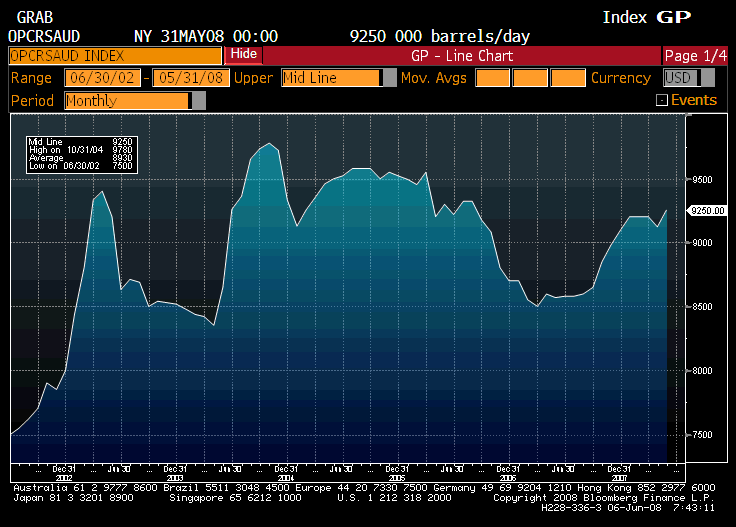
May 2008 Saudi oil output up

Posted by sada mosler on 6th June 2008


[Skip to the end]

2008-06-06 Saudi Oil Production

Saudi Oil Production

This does not bode well for oil prices.

Increased Saudi output means demand has increased at current prices, and the Saudis (and Russians, etc.) remain firmly positioned as ‘price setter’.

The Saudis continue to have the only excess supply, with about 1.5 million bpd excess capacity.

The Mike Masters sell off seems to be over. Actual legislative effort could cause a subsequent temporary sell off but will not dislodge the Saudis from total control.

The only thing that can dislodge their ability to set price is a net supply response in excess of 5 million bpd, which is highly unlikely in the near future.

Any efforts to increase aggregate demand to support growth will also function to support prices.

My twin themes remain:

  1. Weakness (low domestic demand supported by exports) as GDP muddles through. No recession yet, but could happen down the road should exports falter.
  2. Higher prices as Saudis remain as price setter, continuously hiking prices, and inflation continues to march higher, and our real terms of trade and standard of living continues to deteriorate.

‘Solutions’ remain:

  1. pluggable hybrids – this switches demand from crude to coal, and dislodges the Saudis from being price setter.
  2. dropping the national speed limit to 30 mph for private ground transportation. (Just heard JKG dropped the national limit to 35 mph during WWII)

Biofuels continue to link crude to food, and the political response to food shortages and markets allocating life by price is likely to continue to be ‘cash’ payments regardless of inflationary consequences. The body count is likely to exceed that of WWII over the next few years and is probably already in the millions.


[top]

http://moslereconomics.com/wp-content/plugins/sociofluid/images/digg_48.png http://moslereconomics.com/wp-content/plugins/sociofluid/images/stumbleupon_48.png http://moslereconomics.com/wp-content/plugins/sociofluid/images/delicious_48.png http://moslereconomics.com/wp-content/plugins/sociofluid/images/newsvine_48.png http://moslereconomics.com/wp-content/plugins/sociofluid/images/technorati_48.png http://moslereconomics.com/wp-content/plugins/sociofluid/images/facebook_48.png http://moslereconomics.com/wp-content/plugins/sociofluid/images/twitter_48.png

Posted in Oil | 7 Comments »

Mexico’s poor get food cash bonus

Posted by sada mosler on 27th May 2008

Right, this was also suggested in a prior email- the political response towards a food shortage would be cash distributions.
Assuming there actually is a world food shortage and the prices are indicative of a world market allocating by price, this doesn´t create any new food but simply adds upward pressure on prices, triggering an international inflation.

Politically, there is no other choice but to add to inflation like this to at least be seen to be doing something.

Mexico’s poor get food cash boost

The Mexican government is to give its poorest citizens a monthly cash payment of 120 pesos ($11.55; £5.85) to help them cope with rising food prices.

The news came a day after the country said it would cut tariffs on imported crops such as corn, wheat and rice.

In a further sign of the impact of rising food and fuel costs, inflation in Vietnam jumped to 25% in May, the highest rate for 10 years.
Average food costs have risen by 42.4% in a year, the Statistics Office said.

Growing demand
In Mexico, official figures show consumer prices rose by 4.55% – the fastest rate for three years – in the 12 months to 30 April, led by increases in the cost of tomatoes, chicken and cooking oil.

Growing demand from fast-expanding countries such as India and China has been blamed for spiralling food prices, along with record fuel costs and the use of grain to produce bio-fuels.

Governments around the world are under pressure to intervene to help the poorest cope with the sharp food price rises.

There have been public demonstrations about food prices in a number of countries including Egypt and South Africa.

Mexico’s monthly cash payment, which will go to 26 million people in the Latin American country, equates to just over twice the national daily minimum wage of 50 pesos.

The government faced street protests last year when the price of tortillas doubled.

Rice restrictions
Vietnam has seen the price of rice, its staple food, jump 67.8% in the last 12 months, according to government figures.

One of Vietnam’s most important sources of imported rice, Cambodia, stopped exporting the grain in March.

It is one of a number of rice-producing countries, including India, Egypt and Indonesia, to have either banned or restricted exports in recent months to secure supply for domestic customers.

On Tuesday, Cambodia was set to resume exports of rice after its two-month ban ended.

Prime Minister Hun Sen said only rice that was not needed for domestic consumption could be sold for overseas consumption until the new harvesting season began in December.

Last year, that amounted to 1.6 million tons of milled rice.

http://moslereconomics.com/wp-content/plugins/sociofluid/images/digg_48.png http://moslereconomics.com/wp-content/plugins/sociofluid/images/stumbleupon_48.png http://moslereconomics.com/wp-content/plugins/sociofluid/images/delicious_48.png http://moslereconomics.com/wp-content/plugins/sociofluid/images/newsvine_48.png http://moslereconomics.com/wp-content/plugins/sociofluid/images/technorati_48.png http://moslereconomics.com/wp-content/plugins/sociofluid/images/facebook_48.png http://moslereconomics.com/wp-content/plugins/sociofluid/images/twitter_48.png

Posted in Energy | No Comments »

Havana Billboard

Posted by sada mosler on 19th May 2008


[Skip to the end]

2008-05-19 Havana Billboard


[top]

http://moslereconomics.com/wp-content/plugins/sociofluid/images/digg_48.png http://moslereconomics.com/wp-content/plugins/sociofluid/images/stumbleupon_48.png http://moslereconomics.com/wp-content/plugins/sociofluid/images/delicious_48.png http://moslereconomics.com/wp-content/plugins/sociofluid/images/newsvine_48.png http://moslereconomics.com/wp-content/plugins/sociofluid/images/technorati_48.png http://moslereconomics.com/wp-content/plugins/sociofluid/images/facebook_48.png http://moslereconomics.com/wp-content/plugins/sociofluid/images/twitter_48.png

Posted in Energy | No Comments »

UBS: China’s energy imports soar by the back door!!!!

Posted by sada mosler on 9th May 2008


[Skip to the end]

Report by Andrew at UBS LIMITED

China – You will have seen in the FT that China plans to encourage its agricultural industry to start buying up land in Africa and Latin America to grow crops on for the Chinese market.

Last year the Chinese National Development & Reform Commission said that China will import the equivalent of 6% of the U.S. corn harvest by 2010. That works out at 38% of U.S. exports or 25% of world exports. A week or two back the Chinese Academy of Social Sciences said that China now has a shortfall of agricultural land equivalent to 17% of what it needs to support its population. Yesterday the Ministry of Agriculture said it is becoming increasingly difficult to sustain self-sufficiency.

This is why global grain prices are soaring, and are going to continue soaring. It is due to top soil mining and water depletion in China, and they are now clearly starting to call on the rest of the world to do the same.

Putting aside the strain this will have on the rest of the world’s land, it also does two other things. Grains have 2 real inputs. Energy (fertilizers) and water. So by importing grains, it is importing embedded energy and embedded water, and on a HUGE scale.

China is running out of water and is going through peak coal production, but rather than buying the energy on the open market and then desalinating the water it needs – (it would require 3% of world oil production to desalinate the scale of water needed just to stand still) – it is going to buy this in an embedded form. It does make some sense in that China has depleted its land so aggressively – (it has lost about 75% of its top soil in the last 30 years, and is consuming way beyond sustainable levels of water) that it will take less energy to produce grains in other parts of the world than in China, BUT that means paying world prices for the energy rather than with Chinese subsidized fertilizer and water prices. Food prices are going to soar. The terms of trade are going to continue to move against China.

You will have seen today that Thailand is warning that its rice yield could fall by 75% by year end. To meet global needs, it is doing a 3 crop harvest this year. That means the land is getting no respite, and the paddy fields are exhausting its water resources. The head of the government’s rice department has warned that this could seriously damage yields for many years, losing it the position as the world’s largest rice exporter. Rice is a very nitrogen dependent crop. That is why it is grown in paddy fields as the water stops nitrogen loss from the soil, and nitrogen rich algae grow on the stagnant water to form a living fertilizer. With the water depleting, Thailand is having to turn to buying nitrogen based fertilizers (natural gas is the cheapest way of making this), adding to the global call on energy.

Quite frankly, food and energy prices are only going one way until Chinese demand is priced out of the market. The problem is that China’s lands and water are so destroyed now, that it is going to become increasingly impossible for it to maintain existing production. Talk of bringing more land in the old Soviet Union or Africa under production seems wishful thinking. If you recall the Soviet Union destroyed its own land in the 1960’s under the various 5 year plans which caused it to import 25% of the U.S. grain harvest in the 1970’s causing the food price rises then. African land quality is also generally poor – (Northern African soils destroyed by the Roman Empire’s over exploitation, and then in recent years the use of fertilizers managed to lift agricultural yields heavily, but the land has deteriorated at the same time), and Africa, like Eastern Europe (and in fact every continent other than North America is a net grain importer. Food and energy price inflation is not a temporary issue, prices are going higher.

Dave from AVM comments on the article:

Good piece, highlights a few more things we have been talking about for a few months:

  1. Farming inputs ARE energy and water, energy for fertilizer (NG) and also diesel/kero for farm equipment (together something like 50+% of US farmer’s COGS)
  2. Diesel also a call on NG, as “cleaning” fuel (lowering sulfur content) requires hydrogen which is usually a byproduct of active gasoline refining (not this year, yet). In the absence of an increase in refinery utilization rates, hydrogen will be increasingly cracked with natural gas (which is still cheap fuel versus petroleum on a molecular basis)
  3. China also importing more LNG on long term contract basis, putting pressure on domestic US natural gas prices (we have to compete for LNG cargos (spot) when there are domestic NG shortages [we have a 300bcf deficit today to last year's levels, before summer cooling demand begins in earnest])
  4. Coal issues mentioned are true, but coal still difficult to trade effectively. Better expressed in regional power markets.
  5. Abandoning ethanol mandates now (as opposed to Nov EPA vote) to have little impact on ethanol/implied corn demand with crude 120+

We think grains and natural gas prices to rise jointly over next 6 months by 20%+. Power to follow but with extremely high volatility in the summer months, and large positive skew in the shoulders (june and sep).

If food’s as tight as indicated below, world tensions will get a lot worse than anyone currently imagines, including large regional wars.

Eliminating biofuels could buy a few years, cutting national speed limits a few more and perhaps even stabilize things for the next 25 years.


[top]

http://moslereconomics.com/wp-content/plugins/sociofluid/images/digg_48.png http://moslereconomics.com/wp-content/plugins/sociofluid/images/stumbleupon_48.png http://moslereconomics.com/wp-content/plugins/sociofluid/images/delicious_48.png http://moslereconomics.com/wp-content/plugins/sociofluid/images/newsvine_48.png http://moslereconomics.com/wp-content/plugins/sociofluid/images/technorati_48.png http://moslereconomics.com/wp-content/plugins/sociofluid/images/facebook_48.png http://moslereconomics.com/wp-content/plugins/sociofluid/images/twitter_48.png

Posted in Articles, China | 5 Comments »

Bloomberg: ‘Silent Famine’ as Food Soars

Posted by sada mosler on 22nd April 2008

Seems they still think it is about money.

Probably an actual shortage at this point.

The political response will be to give people more funds to buy food that does not exist and drive prices ever higher.

`Silent Famine’ as Food Soars, WFP Warns

by Jason Gale and Paul Gordon

(Bloomberg) A “silent famine” risks emerging in some Asian countries where food prices including rice are escalating beyond the reach of the poorest people, the World Food Program warned.

“There is food on the counters and on the shelves in stores but there is a certain population that cannot afford that food,” Paul Risley, a spokesman for the United Nations agency, said today. “There’s a risk of a silent famine.”

Record prices for rice and wheat are ratcheting up the cost to aid agencies of providing relief, Risley said from Bangkok. UN Secretary-General Ban Ki-Moon said yesterday that rising food costs may hurt economic growth and threaten political security.

“In Asia, supply is not the main constraint, but the huge price increases are,” said Rajat Nag, managing director at the Asian Development Bank. “That has a very massive impact on the poor and we need to focus on the huge price increases.”

`We’re Struggling’
“We find we can’t buy as much rice as we thought we would be able to buy,” Risley said in an interview with Bloomberg Television. The agency feeds 28 million of the poorest Asians across 14 countries. “Because of the high prices right now, we’re struggling,” he said.

http://moslereconomics.com/wp-content/plugins/sociofluid/images/digg_48.png http://moslereconomics.com/wp-content/plugins/sociofluid/images/stumbleupon_48.png http://moslereconomics.com/wp-content/plugins/sociofluid/images/delicious_48.png http://moslereconomics.com/wp-content/plugins/sociofluid/images/newsvine_48.png http://moslereconomics.com/wp-content/plugins/sociofluid/images/technorati_48.png http://moslereconomics.com/wp-content/plugins/sociofluid/images/facebook_48.png http://moslereconomics.com/wp-content/plugins/sociofluid/images/twitter_48.png

Posted in Articles, Energy | 1 Comment »

NYT: Let them eat corn

Posted by sada mosler on 15th April 2008

Says it all about politics:

Fuel Choices, Food Crises and Finger-Pointing

by Andrew Martin

Senator Charles E. Grassley, Republican of Iowa, called the recent criticism of ethanol by foreign officials “a big joke.” He questioned why they were not also blaming a drought in Australia that reduced the wheat crop and the growing demand for meat in China and India.

“You make ethanol out of corn,” he said. “I bet if I set a bushel of corn in front of any of those delegates, not one of them would eat it.”

http://moslereconomics.com/wp-content/plugins/sociofluid/images/digg_48.png http://moslereconomics.com/wp-content/plugins/sociofluid/images/stumbleupon_48.png http://moslereconomics.com/wp-content/plugins/sociofluid/images/delicious_48.png http://moslereconomics.com/wp-content/plugins/sociofluid/images/newsvine_48.png http://moslereconomics.com/wp-content/plugins/sociofluid/images/technorati_48.png http://moslereconomics.com/wp-content/plugins/sociofluid/images/facebook_48.png http://moslereconomics.com/wp-content/plugins/sociofluid/images/twitter_48.png

Posted in Energy | 4 Comments »

Food

Posted by sada mosler on 12th April 2008

On the current food shortages and protests created by biofuels (as feared):

The mainstream ‘Malthusian’ world is one where the population grows to the size of the food supply.

Now we have a new twist on that theme.

The monetary system burns up the food supply as fuel to the point where the marginal agent facing starvation has sufficient political influence to stop this process.

The first phase is happening as politicians around the world are allocating more funds to people who can’t afford to eat.

This only drives up the price further as markets continue to allocate by price, with no sign of a sufficient supply response to keep many from starvation.

In fact, newly emerging nations are producing income distributions that allow their higher income groups to reduce the aggregate food supply by both consuming more fuel and also by increasing meat consumption.

I expect a lot worse before it gets better.

http://moslereconomics.com/wp-content/plugins/sociofluid/images/digg_48.png http://moslereconomics.com/wp-content/plugins/sociofluid/images/stumbleupon_48.png http://moslereconomics.com/wp-content/plugins/sociofluid/images/delicious_48.png http://moslereconomics.com/wp-content/plugins/sociofluid/images/newsvine_48.png http://moslereconomics.com/wp-content/plugins/sociofluid/images/technorati_48.png http://moslereconomics.com/wp-content/plugins/sociofluid/images/facebook_48.png http://moslereconomics.com/wp-content/plugins/sociofluid/images/twitter_48.png

Posted in Energy | No Comments »

Re: Food prices (cont)

Posted by sada mosler on 9th April 2008

(a set of interoffice emails)

Sanjiv to me
9:10 AM Reply
See the riots in Haiti over food prices?

Mike to me
9:03 AM Reply
Much of it caused by financial intermediaries

YES, TO THE EXTENT THERE ARE EXCESS INVENTORIES.

BIOFUELS, TO THE EXTENT THE FOOD/ACREAGE HAS BEEN USED FOR FUEL

On Wed, Apr 9, 2008 at 9:02 AM, Brian wrote:

Did you see the news in the Philippines last night? The government is going to start increasing wages to help people deal with rising food and energy costs. Interesting approach toward combating inflation.

Yes, the mainstream calls that ‘monetizing’ the price increases. Given a shortage, giving people more funds doesn’t add to supply in the short run, and, (twist on Keynes coming) when it comes to food shortages in the short run we’re all dead.

http://moslereconomics.com/wp-content/plugins/sociofluid/images/digg_48.png http://moslereconomics.com/wp-content/plugins/sociofluid/images/stumbleupon_48.png http://moslereconomics.com/wp-content/plugins/sociofluid/images/delicious_48.png http://moslereconomics.com/wp-content/plugins/sociofluid/images/newsvine_48.png http://moslereconomics.com/wp-content/plugins/sociofluid/images/technorati_48.png http://moslereconomics.com/wp-content/plugins/sociofluid/images/facebook_48.png http://moslereconomics.com/wp-content/plugins/sociofluid/images/twitter_48.png

Posted in Email | 2 Comments »

Delta Farm Press: aggregate demand

Posted by sada mosler on 6th March 2008

Looks like inflation as measured keeps ripping.True, there isn’t a shortage of available crude. the issue is that at the margin the available crude is sold by a ’swing producer’ /monopolist who can hike prices indefinitely until there is a supply response as in the 1980’s when OPEC production dropped by 15 million bpd as they attempted to hold up prices.

I don’t see that kind of supply response this time around any time soon.

Markets volatile with index funds influence, bio-fuel requirements

by David Bennett
Farm Press Editorial Staff

The grain and livestock industries have experienced a certain change in attitude since USDA’s late January crop report.

RICHARD BROCK, right, author of the Brock Report, and Carl Brothers, vice president at Riceland Foods, both spoke at the recent 2008 ASU Agribusiness Conference in Jonesboro, Ark.

Several weeks ago, agriculture economist Richard Brock was at a conference with a professor from Kansas State University who “… indicated that currently in Kansas there’s such a quick liquidation that there’s a three-year wait to get slaughter space for sows.

“There is a wait list, but I don’t think it’s three years. In Illinois, we’re seeing a lot of 1,000- to 1,300-sow units being liquidated,” said Brock, author of the Brock Report and contributor to Delta Farm Press, at Arkansas State University’s Agribusiness Conference in Jonesboro, Ark., on Feb. 13.

Regardless, if the corn market isn’t corrected soon, “frankly there will be irreparable damage in the pork industry. Pork prices will be absolutely through the roof in 12 to 18 months.”

As for problems the poultry industry is having, it was announced in early February prices for chicken breasts are set to rise 7 to 10 percent. “We’re seeing probably a cutback in poultry for the first time since I’ve been in business over 30 years. So there are repercussions from this strong grain market and changing world.”

In the grain elevator business, “the last three weeks have been the most chaotic I’ve ever seen. A week ago, I was speaking at the Minnesota Feed and Grain Convention. I had dinner with a banker from a large, national bank the night before. Just (days) before they’d notified some of their clients, independent grain elevator operators, not to come back for additional lines of credit.”

There are “huge problems” in the grain elevator business. “If they can’t increase a line of credit, they must liquidate their position. That means an increasingly wide basis.”

Further, a large, regional Midwest elevator company announced two weeks it wouldn’t even make bids for new-crop soybeans, wheat or corn. A farmer in that region “can’t even get a price, right now. These are some of the issues the industry as a whole will be facing.”

Economic rules
While studying agriculture economics at Purdue University, one of Brock’s professors said, “the laws of economics have never been repealed and probably never will be. If you keep the price of any commodity too high, too long, someone will find a way to produce more of it, use less of it or use something else.”

Brock finds that “particularly true of the energy market, right now. We’ve kept prices much too high for way too long. We don’t have a shortage of energy, of crude oil. We have a perceived shortage of crude oil.

“The only time we’ve had a real energy shortage was in 1973. That’s the only time I can remember lines at gas stations because of shortages.”

What is happening now is a huge change in technology. For example, China has eight nuclear plants under construction with 45 others on the drawing board.

Few are aware that within the next 18 months, six nuclear plants will start up in the United States, the first built in the country since the frightening Three-Mile Island incident in 1979.

Meanwhile, “if you drive through the Midwest, you can’t go 10 miles without seeing windmill farms. They’re going up everywhere.”

Regarding the value of the U.S. dollar, Brock takes a position contrary to many agriculture economists. “I don’t understand why a lot of the press and ag economists have convinced producers that a cheap dollar is good for us. I think — particularly if you’re a corn or soybean farmer — a cheap dollar hurts more than helps.”

The value of the dollar is a relative issue. “We don’t compete against anyone in the corn market so what difference does the value of the dollar make? We’re the majority of the world’s corn export market. We have no significant competition.”

Last year, the United States exported more corn at $4.50 than it did two years ago at $2. Is there any correlation between the value of the dollar and price of corn? “Countries buy corn based on need not price.”

What about soybeans U.S. farmers are competing against in South America? “Again, show me a correlation between the value of our currency and Brazil’s and soybean exports. My guess is you’d find a much stronger correlation between ocean freight rates and soybean exports.”

Fifty percent of the nitrogen used in U.S. agriculture is now imported along with 80 percent of the potash. What has really happened “is the value of the dollar has substantially increased the price of our inputs. And I’d argue it has helped the selling price not at all. Yet, for some reason, we’re led to believe the (lower) value of the dollar is good for us.”

Funds
Very few are aware one of the biggest issues impacting U.S. agriculture are index funds.

“There are two commodity funds. Regular funds can be both long and short. In 2002, those had about $51 billion in. By last September, the most recent data, that number had risen to about $185 billion.”

The real issue, though, is with index funds. “The granddaddy of them is the Goldman and Sachs Index Fund. Our last estimate was it had $103 billion.”

Three or four years ago, any fund that traded commodities was subject to position limits. Suppose the position limit on corn was around 18 million bushels. “If you’re a manager of a Goldman Sachs fund and the market moves $1, that’s (potentially) $18 million dollars. That’s a lot of money to us but if you’re working with $103 billion, it’s a pimple on an elephant’s back.”

So the index funds petitioned the Commodity Futures Trading Commission (CFTC) to be classified as commercial companies. The limits on a commercial company like ADM or Cargill are only the amounts of grain being sold or bought.

Meanwhile, the index fund companies don’t have any grain, only cash. Their only limit is the amount of money on hand. This allows them to go long on as much corn, beans, wheat and crude oil as they have cash.

There are smaller index funds “and they all have perspectives and must maintain balances at the end of each month. For the Goldman Sachs fund, 74 percent of its money must be invested in the energy market. In other words, the fund has $75 billion to be used in crude oil and gas futures. Further, 8.2 percent of its money must be traded in grain markets.

“Think about this, the fund has $8.5 billion for corn, soybeans and wheat and $74 billion for crude oil and heating oil. I never thought I’d be considering a conspiracy theory. But I can see a novel being written in about five years as to where the money was coming from for these funds. Wouldn’t it be ironic if we discovered that of that $103 billion, a lot is oil money from the Middle East. And the fund is self-perpetuating: put the money in the fund, they have unlimited access to buying oil futures to keep the price of oil up and keep the flow of money going. I’m not saying that’s happening, but I’ve seen stranger things.”

What does worry Brock is that, as of a month ago, the index funds position in Chicago on soft red winter wheat represented 270 percent of the crop.

“That was the position! People wonder why the wheat market is so volatile — because the funds are buying more wheat than we produce. In the corn market, (the funds) represent only about 15 percent of the crop. They actually have a current position in cotton of over 50 percent of the crop.”

The largest long position is held by the index funds — currently long on about 400,000 corn contracts. “That’s 2 billion bushels of corn. The regular funds are long on another 100,000 contracts. So, between the two types of funds, they’re long on over 3 billion bushels of corn.”

Brock is unsure of a solution. However, the livestock and poultry industries are “all over” the CFTC to get regulations changed.

The index funds distort the market, insists Brock. With such a high futures market, “the cash can’t keep up. There are basis swings like we’ve never seen before because the grain elevators can’t meet margin calls.

“The one thing that could happen is — and let’s use the Goldman Sachs fund as an example — if, hypothetically, crude oil dropped $15 a barrel. At the end of the month, the fund must adjust assets.” If all other commodities stay the same and no other cash flow is coming into the fund, “they’ll have to sell corn, soybeans, wheat and cotton in order to bring their percentages back in line.

“If they have more money coming into their fund, though, instead of selling corn, beans, wheat and cotton they could buy more energy to maintain the monthly balances.”

Fuel
Currently, there are 127 U.S. ethanol plants with an average capacity of 59 million gallons. There are 68 facilities under construction with an average capacity of 84 million gallons. Another 88 facilities are on the drawing board with over 89 million gallons of capacity.

“If you take a look at the mandate in the energy bill that just passed, 36 billion gallons of ethanol (are required) by 2015 and 15 billion of that is to come from corn.… In 12 to 18 months, we’ll already be producing enough ethanol with what’s already under construction to reach the 2015 mandate.”

If the plants proposed are built, by 2015 the United States will produce about 22 billion ethanol. “But I don’t think we’ll get there because of what’s happened in the last month. By year’s end, in Illinois 22 percent of the corn crop will be used for ethanol. In Indiana 41 percent, Iowa 53 percent, Kansas 38 percent, Kentucky 8 percent, Nebraska 40 percent, North Dakota 45 percent, South Dakota 58 percent.

Ohio — which a year ago was at zero — will be at 35 percent. Ohio has always been a corn-deficit state because it ships corn east and southeast to pork and poultry industries. Here they are, already in a corn deficit, and now 35 percent of their crop will be in an ethanol plant. That doesn’t make a lot of sense, but it’s being done.”

With current corn prices, some ethanol plants are losing money. “I received an e-mail last night from the president of a feed company in California. He named three (plants) that are under construction and have stopped building and six plants that were on the drawing board and (have been dropped).

“I think what the industry will find is if the corn market stays high much longer, a lot of the plants being planned will disappear. We won’t reach the big (predictions) made.

“This industry has changed enormously in just the last six weeks. The economics have changed because of the price of corn.”

Another issue in California is almost all of the corn used for ethanol is coming from Nebraska, South Dakota and Minnesota.

This year, there’s plenty of corn. However, next year is a concern.

“Corn can be found, but as anyone in the railroad industry knows, the problem is there aren’t enough railcars to get it from the western Corn Belt to California. And even if you could get the railcars, there isn’t enough track. It isn’t like building a new track through Arkansas — there are these things called the Rocky Mountains that aren’t flat. Getting new track built won’t happen.”

Ethanol is about $2.20 per gallon. That means using a break-even formula, $6 corn is required. In California, by the time “they pay about $1.40 per bushel to get the corn from the western Corn Belt the price (is too high). That’s why some plants are shutting down.”

Brock estimates that about 3.2 billion corn bushels from this year’s crop will go to ethanol. Next year, he says, the number will be between 3.8 billion and 4 billion.

A possible bearish factor to add to the mix: the 54-cent tariff on imported ethanol expires in 11 months.

“If you’d asked me three months ago about the chances of that being renewed, I’d have said 95 percent. But with political pressure in Washington, D.C., right now, I’m not so sure it’ll be renewed. It’s up in the air and might depend on who the next president is.”

Genetics and enzymes
The next thing that could change things around is genetic improvements. “Talk to executives at Pioneer and Monsanto and they’ll say a 10-bushel-per-acre increase in the next two years is inevitable. Most are more optimistic than that. Add 10 bushels to the corn yield and it would solve a lot of problems. We’d have corn running out of our ears.”

Two weeks ago, Brock made a mistake while giving a speech. “I said someone would be coming along with an enzyme that would allow poultry and pork to digest more than the 10 percent of DDG (Dry Distillers Grain) equivalent in their rations.”

As soon as the speech was over, “some executives (approached me and explained) they’d released a product called Allzyme SSF about a month ago. This is being commercially marketed to the poultry and pork companies. If (it works), this would change the demand for corn quite a bit. DDG could be fed more aggressively to poultry.”

http://moslereconomics.com/wp-content/plugins/sociofluid/images/digg_48.png http://moslereconomics.com/wp-content/plugins/sociofluid/images/stumbleupon_48.png http://moslereconomics.com/wp-content/plugins/sociofluid/images/delicious_48.png http://moslereconomics.com/wp-content/plugins/sociofluid/images/newsvine_48.png http://moslereconomics.com/wp-content/plugins/sociofluid/images/technorati_48.png http://moslereconomics.com/wp-content/plugins/sociofluid/images/facebook_48.png http://moslereconomics.com/wp-content/plugins/sociofluid/images/twitter_48.png

Posted in Articles, Inflation | No Comments »

Stagflation

Posted by sada mosler on 8th February 2008

Yes, the below analysis has also been the Fed’s position, up until this week’s speeches.

It’s been about a crude/food/$ negative supply shock, supported by Saudis/Russians acting as swing producer and biofuels linking crude prices to food prices.

The fed has called the price hikes relative value stories that they don’t want turning into an inflation story. They feel they have room to cut rates as long as expectations stay well anchored, which includes wage demands but other things as well.

Yellen the dove, along with the hawks, now saying inflation expectations are showing signs of elevating, and saying energy costs are being passed through to core inflation is a departure from previous Fed rhetoric and may signal they are at or near their limits regarding ff cuts (data dependent, of course).

Also, Bernanke pushing Congress and the President to add to the deficit could also be a sign he is reaching his inflation tolerance regarding lowering the FF rate. The mainstream belief is that inflation is a function of monetary policy, not fiscal policy.

Now with the ECB perhaps throwing in the towel on inflation as well, look at how the commodities are responding. ‘Cost push inflation’ is ripping, and the perception is the CB’s around the world will act to sustain demand, including pushing for larger fiscal deficits.

Difficult to explain why so many have stagflation on the brain It is difficult to explain why so many folks still have stagflation or inflation on the brain just because wheat prices have soared to new highs. We have to distinguish between relative and absolute pricing. Not only that, but unlike the 1970s, the current ‘inflation’ backdrop is much more narrowly confined. The key is the labor market. And here we have a 4-quarter growth rate in unit labor costs of a mere 1% in 4Q (a three-year low), which compares to 4% heading into the 2001 downturn. In other words, as far as the labor market is concerned, inflation is less of a threat to the economy than it was at this same stage of the cycle seven years ago. In fact, heading into the 1990 recession, the trend in ULC was also 4% – the Fed sliced the funds rate from almost 10% to 3% that cycle, for crying out loud. In fact, scouring more than 50 years’ worth of data, at no time in the past has the year-to-year trend in unit labor costs been as low as it is today heading into an official recession. Make no mistake, deflation is going to emerge as the next major macro theme.


♥

http://moslereconomics.com/wp-content/plugins/sociofluid/images/digg_48.png http://moslereconomics.com/wp-content/plugins/sociofluid/images/stumbleupon_48.png http://moslereconomics.com/wp-content/plugins/sociofluid/images/delicious_48.png http://moslereconomics.com/wp-content/plugins/sociofluid/images/newsvine_48.png http://moslereconomics.com/wp-content/plugins/sociofluid/images/technorati_48.png http://moslereconomics.com/wp-content/plugins/sociofluid/images/facebook_48.png http://moslereconomics.com/wp-content/plugins/sociofluid/images/twitter_48.png

Posted in Energy, Interest Rates, Oil, USA | 2 Comments »

Re: UN Warns of Biofuels’ Environmental Risk

Posted by sada mosler on 25th January 2008

(an email)

THANKS, DAVID, COMMENTS BELOW IN CAPS

>    Subject: UN Warns of Biofuels’ Environmental Risk
>
>
>   By MICHAEL CASEY
>   AP Environmental Writer
>   BANGKOK, Thailand
>
>   The world’s rush to embrace biofuels is causing a spike in the price of corn
>   and other crops

THE REASON THE PRICE IS GOING UP IS THAT HUNGRY PEOPLE ARE COMPETING
FOR WHAT’S LEFT TO EAT AFTER THE ACREAGE GOES TO FUEL PRODUCTION

and could worsen water shortages and force poor communities off
>   their land, a U.N. official said Wednesday.

FORCING PEOPLE OFF THE LAND IS SECONDARY TO FOOD AND WATER SHORTAGES?

>   Foremost among the concerns is increased competition for agricultural land,
>   which Suzuki warned has already caused a rise in corn prices in the United
>   States and Mexico and could lead to food shortages in developing countries.
>
>   She also said China and India could face worsening water shortages because
>   biofuels require large amounts of water, while forests in Indonesia and
>   Malaysia could face threats from the expansion of palm oil plantations.

also:

The New York Times
Governments in Europe and elsewhere have begun rolling back generous,
across-the-board subsidies for biofuels, acknowledging that the
environmental benefits of these fuels have often been overstated.

SEEMS THAT THE POTENTIAL TO STARVE TENS OF MILLIONS OF PEOPLE TO DEATH
TAKES SECOND PLACE TO ENVIRONMENTAL CONCERNS.

UNTIL THAT HAPPENS, GOVTS WILL PROBABLY CONTINUE THE CURRENT LEVEL OF
SUPPORT AND KEEP FOOD PRICES LINKED TO FUEL,

THIS IS PROBLEMATIC FOR THE FED AS CPI WILL KEEP RISING WITH GASOLINE
PRICES, WHICH WILL DRAG FOOD ALONG WITH IT. AND BOTH OF THESE FEED
INTO THE COST SIDE AND PUSH UP CORE MEASURES AS WELL.


♥

http://moslereconomics.com/wp-content/plugins/sociofluid/images/digg_48.png http://moslereconomics.com/wp-content/plugins/sociofluid/images/stumbleupon_48.png http://moslereconomics.com/wp-content/plugins/sociofluid/images/delicious_48.png http://moslereconomics.com/wp-content/plugins/sociofluid/images/newsvine_48.png http://moslereconomics.com/wp-content/plugins/sociofluid/images/technorati_48.png http://moslereconomics.com/wp-content/plugins/sociofluid/images/facebook_48.png http://moslereconomics.com/wp-content/plugins/sociofluid/images/twitter_48.png

Posted in Email | No Comments »

If it isn’t inflation, what is it?

Posted by sada mosler on 14th January 2008

What we used to call an ‘inflation day’ -

  • $ down/oil up
  • Gold through 900- if nothing else, it’s an inflation expectation indicator (not that they cause anything, just reflect it)
  • Other metals up
  • Grains going parabolic
  • Stocks up

also,

  • Export driven growth means demand coming from and output going to non residents, rather than retail sales and other domestic consumption.
  • Changes of portfolio currency preferences away from the $US are driving the dollar down to low enough levels where non residents buy here to use up some of their $US financial assets.
  • Japan/mof (and others) would probably like to buy $ to keep the yen from rising and hurting their exports, but Paulson has warned the world CB’s that this makes them ‘currency manipulators’ and subject to criticism.

This is an explicit weak $ policy that is probably altering CB portfolio preferences and inducing price pressures on our imports.

The Fed is sending signals it’s fine with this kind of inflation at least as long as they are forecasting the risk of weaker domestic demand as a result (somehow) of financial concerns. And because they analyze the risks as if we had a fixed exchange rate they see the risks of supply side credit issues as those of the great depression of the 1930’s. Doesn’t happen with today’s floating fx.

Don’t know when/if the Fed ‘figures it out’ but the curve can go from wherever it is to seriously negative should the Fed hike aggressively to ‘get ahead of the inflation curve.’

The inflation is coming from non monetary sources – monopolist pricing in oil, biofuels linking food to fuel, portfolio shifts out of $US due to US political rhetoric and apparent Fed policy of inflating your way out of debt without concern for the value of the currency. Enough to scare any portfolio manager out of $US risk.


♥

http://moslereconomics.com/wp-content/plugins/sociofluid/images/digg_48.png http://moslereconomics.com/wp-content/plugins/sociofluid/images/stumbleupon_48.png http://moslereconomics.com/wp-content/plugins/sociofluid/images/delicious_48.png http://moslereconomics.com/wp-content/plugins/sociofluid/images/newsvine_48.png http://moslereconomics.com/wp-content/plugins/sociofluid/images/technorati_48.png http://moslereconomics.com/wp-content/plugins/sociofluid/images/facebook_48.png http://moslereconomics.com/wp-content/plugins/sociofluid/images/twitter_48.png

Posted in USA | No Comments »

Crisis may make 1929 look a ‘walk in the park’

Posted by WARREN MOSLER on 1st January 2008

Crisis may make 1929 look a ‘walk in the park’

Telegraph
by Ambrose Evans-Pritchard

As central banks continue to splash their cash over the system, so far to little effect, Ambrose Evans-Pritchard argues that things risk spiralling out of their control

Twenty billion dollars here, $20bn there, and a lush half-trillion from the European Central Bank at give-away rates for Christmas.
Buckets of liquidity are being splashed over the North Atlantic banking system, so far with meagre or fleeting effects.

It’s about price, not quantity (net funds are not altered), and the CB actions have helped set ‘policy rates’ at desired levels.

That is all the CBs can do, apart from altering the absolute level of rates, which, by their own research, does little or nothing and with considerable lags.

Not to say changing rates isn’t disruptive as it shifts nominal income/wealth between borrowers and savers of all sorts.

As the credit paralysis stretches through its fifth month, a chorus of economists has begun to warn that the world’s central banks are fighting the wrong war, and perhaps risk a policy error of epochal proportions.

“Liquidity doesn’t do anything in this situation,” says Anna Schwartz, the doyenne of US monetarism and life-time student (with Milton Friedman) of the Great Depression.

The last major, international fixed exchange rate/gold standard implosion. Other since – ERM, Mexico, Russia, Argentina – have been ‘contained’ to the fixed fx regions.

“It cannot deal with the underlying fear that lots of firms are going bankrupt. The banks and the hedge funds have not fully acknowledged who is in trouble. That is the critical issue,” she adds.

The critical issue at the macro policy level is what it is all doing to the aggregate demand that sustains output, employment, and growth. So far so good on that front, but it remains vulnerable, especially given the state of knowledge of macro economics and fiscal/monetary policy around the globe.

Lenders are hoarding the cash, shunning peers as if all were sub-prime lepers. Spreads on three-month Euribor and Libor – the interbank rates used to price contracts and Club Med mortgages – are stuck at 80 basis points even after the latest blitz. The monetary screw has tightened by default.

The CB can readily peg Fed Funds vs. LIBOR at any spread they wish to target.

York professor Peter Spencer, chief economist for the ITEM Club, says the global authorities have just weeks to get this right, or trigger disaster.

Seems they pretty much did before year end. Spreads are narrower now and presumably at CB targets.

“The central banks are rapidly losing control. By not cutting interest rates nearly far enough or fast enough, they are
allowing the money markets to dictate policy. We are long past worrying about moral hazard,” he says.

They have allowed ‘markets’ to dictate as the entire FOMC and others have revealed a troubling lack of monetary operations and reserve accounting.

“They still have another couple of months before this starts imploding. Things are very unstable and can move incredibly fast. I don’t think the central banks are going to make a major policy error, but if they do, this could make 1929 look like a walk in the park,” he adds.

Hard to do with floating exchange rates, but not impossible if they try hard enough!

The Bank of England knows the risk. Markets director Paul Tucker says the crisis has moved beyond the collapse of mortgage securities, and is now eating into the bedrock of banking capital. “We must try to avoid the vicious circle in which tighter liquidity conditions, lower asset values, impaired capital resources, reduced credit supply, and slower aggregate demand feed back on each other,” he says.

Seems a lack of understanding of the ’suppy side’ of money/credit is pervasive and gives rise to all kinds of ‘uncertainties’ (AKA – fears, as in being scared to an extreme).

New York’s Federal Reserve chief Tim Geithner echoed the words, warning of an “adverse self-reinforcing dynamic”, banker-speak for a downward spiral. The Fed has broken decades of practice by inviting all US depositary banks to its lending window, bringing dodgy mortgage securities as collateral.

Banks can only own what the government puts on their ‘legal list’, and banks can issue government insured deposits, which is government funding, in order to fund government approved assets.

Functionally, there is no difference between issuing government insured deposits to fund their legal assets and using the discount window to do the same. The only difference may be the price of the funds, and the fed controls that as a matter of policy.

Quietly, insiders are perusing an obscure paper by Fed staffers David Small and Jim Clouse. It explores what can be done under the Federal Reserve Act when all else fails.

Section 13 (3) allows the Fed to take emergency action when banks become “unwilling or very reluctant to provide credit”. A vote by five governors can – in “exigent circumstances” – authorise the bank to lend money to anybody, and take upon itself the credit risk. This clause has not been evoked since the Slump.

The government already does this. They already determine legal bank assets, capital requirements, and via various government agencies and association advance government guaranteed loans of all types.

This is business as usual – all presumably for public purpose.

Get over it!!!

Yet still the central banks shrink from seriously grasping the rate-cut nettle. Understandably so. They are caught between the Scylla of the debt crunch and the Charybdis of inflation. It is not yet certain which is the more powerful force.

Yes, as they cling to the belief that ‘inflation’ is a ’strong’ function of interest rates, while it is an oil monopolist or two and a government induced and supported link from crude to food via biofuels that are driving up CPI and inflation in general.

America’s headline CPI screamed to 4.3 per cent in November. This may be a rogue figure, the tail effects of an oil, commodity, and food price spike. If so, the Fed missed its chance months ago to prepare the markets for such a case. It is now stymied.

CPI might also be headed higher if crude continues its advance.

This has eerie echoes of Japan in late-1990, when inflation rose to 4 per cent on a mini price-surge across Asia. As the Bank of Japan fretted about an inflation scare, the country’s financial system tipped into the abyss.

As I recall, it was a tax hike that hurt GDP.

Yes, the world economies are vulnerable to a drop in GDP growth, but the financial press seems to have the reasoning totally confused.


♥

http://moslereconomics.com/wp-content/plugins/sociofluid/images/digg_48.png http://moslereconomics.com/wp-content/plugins/sociofluid/images/stumbleupon_48.png http://moslereconomics.com/wp-content/plugins/sociofluid/images/delicious_48.png http://moslereconomics.com/wp-content/plugins/sociofluid/images/newsvine_48.png http://moslereconomics.com/wp-content/plugins/sociofluid/images/technorati_48.png http://moslereconomics.com/wp-content/plugins/sociofluid/images/facebook_48.png http://moslereconomics.com/wp-content/plugins/sociofluid/images/twitter_48.png

Posted in Articles, Fed, Oil | No Comments »

Saudi/Fed teamwork

Posted by WARREN MOSLER on 26th December 2007

Looks like markets are still trading with the assumption that as the Saudis/Russians hike prices the Fed will accommodate with rate cut.

That’s a pretty good incentive for more Saudi/Russian oil price hikes, as if they needed any!

Likewise, the US is a large exporter of grains and foods.

Those prices are now linked to crude via biofuels.

And the new US energy bill just passed with about $36 billion in subsidies for biofuels to help us keep burning up our food for fuel and keeping their prices linked.

This means cpi will continue to trend higher, and drag core up with it as costs get passed through via a variety of channels. In the early 70’s core didn’t go through 3% until cpi went through 6%, for example.

Ultimately everything is made of food and energy, and margins don’t contract forever with softer demand. In fact, much of the private sector is straight cost plus pricing, and govt is insensitive to ‘demand’ and insensitive to the prices of what it buys. And the US govt. indexes compensation and most transfer payments to (headline) cpi.

And while the US may be able to pay it’s rising oil bill with help from its rising export prices for food, much of the rest of the world is on the wrong end of both and will see its real terms of trade continue to deteriorate. Not to mention the likelihood of increased outright starvation as ultra low income people lose their ability to buy enough calories to stay alive as they compete with the more affluent filling up their tanks.

At the Jan 30 meeting I expect the Fed to be looking at accelerating inflation due to rising food/crude, and an economy muddling through with a q4 gdp forecast of 2-3%. Markets will be functioning, banks getting recapitalized, and while there has been a touch of spillover from Wall st. to Main st. the risk of a sudden, catastrophic collapse has to appear greatly diminished.

They have probably learned that the fed funds cuts did little or nothing for ‘market functioning’ and that the TAF brought ff/libor under control by accepting an expanded collateral list from its member banks.

(In fact, the TAF is functionally equiv of expanding the collateral accepted at the discount window, cutting the rate, and removing the stigma as recommended back in August and several times since.)

And they have to know their all important inflation expectations are at the verge of elevating.

They will know demand is strong enough to be driving up cpi, and the discussion will be the appropriate level of demand and the fed funds rate most likely to sustain non inflationary growth.

Their ‘forward looking’ models probably will still use futures prices, and with the contangos in the grains and energy markets, the forecasts will be for moderating prices. But by Jan 30 they will have seen a full 6 months of such forecasts turn out to be incorrect, and 6 months of futures prices not being reliable indicators of future inflation.

Feb ff futures are currently pricing in another 25 cut, indicating market consensus is the Fed still doesn’t care about inflation. Might be the case!


♥

http://moslereconomics.com/wp-content/plugins/sociofluid/images/digg_48.png http://moslereconomics.com/wp-content/plugins/sociofluid/images/stumbleupon_48.png http://moslereconomics.com/wp-content/plugins/sociofluid/images/delicious_48.png http://moslereconomics.com/wp-content/plugins/sociofluid/images/newsvine_48.png http://moslereconomics.com/wp-content/plugins/sociofluid/images/technorati_48.png http://moslereconomics.com/wp-content/plugins/sociofluid/images/facebook_48.png http://moslereconomics.com/wp-content/plugins/sociofluid/images/twitter_48.png

Posted in Fed, Oil | No Comments »

Senate energy bill keeps biofuels alive

Posted by WARREN MOSLER on 12th December 2007

Senate approves $650M alternative energy billBy MARC LEVY

HARRISBURG, Pa. – Builders of wind farms, owners of coal-fired power plants and buyers of hybrid cars and solar panels would be among those who benefit from a $650 million compromise bill approved Wednesday by the state Senate to promote cleaner energies and conservation.

The measure was approved 44-5 on the Senate’s last day of business for the year. It calls for tax credits, rebates, loans and grants over a decade or more in an effort to cut electricity bills and pollution and make Pennsylvania a destination for a booming renewable and cleaner energy industry.

(snip)

The Senate also passed two biodiesel bills Wednesday. One would require that biodiesel be added to each gallon of diesel sold in Pennsylvania in increasing amounts as in-state production of biodiesel reaches certain levels. The other would raise the in-state biodiesel production subsidy from 5 cents to 75 cents a gallon _ at a cost of about $5 million _ and expand an existing rebate program on purchases of gas-electric hybrid vehicles to other vehicles that burn alternative fuels.

This retains the link between fuel and food as we ‘burn up our food supply’ as we turn it into fuel. Makes fed’s inflation fight that much tougher, as the monetary system will get used whatever fuel can be produced will get used.

“This is a wonderful start and is a great way to end our calendar year with what I think is a great success under our belt,” said Sen. Mary Jo White, the Venango County Republican who was a sponsor of all three bills.


♥

http://moslereconomics.com/wp-content/plugins/sociofluid/images/digg_48.png http://moslereconomics.com/wp-content/plugins/sociofluid/images/stumbleupon_48.png http://moslereconomics.com/wp-content/plugins/sociofluid/images/delicious_48.png http://moslereconomics.com/wp-content/plugins/sociofluid/images/newsvine_48.png http://moslereconomics.com/wp-content/plugins/sociofluid/images/technorati_48.png http://moslereconomics.com/wp-content/plugins/sociofluid/images/facebook_48.png http://moslereconomics.com/wp-content/plugins/sociofluid/images/twitter_48.png

Posted in Oil | No Comments »