
Run on the European banks?
Posted by WARREN MOSLER on April 27th, 2010
When/if word gets out that depositors can lose, that contagion spreads across the euro zone with a general run on the banking system to actual cash, gold, and other currencies, which doesn’t create a cash shortage but drives the euro down further, and further weakens the credit worthiness of all the national govts.
As previously suggested, the endgame is a shut down of the payments system and a reorganization of the entire system with credible deposit insurance and central funding.
My proposal still seems the only one I’ve seen that makes any sense at all, and it’s still not even a consideration.
Europe-wide carnage we saw today.
This is not just about sovereign debt. This is about a concern about the banking system.
The word from S&P is that Greek debt holders will take a major haircut on their holdings, and that means serious problems for banks. (See the full list of victims here)
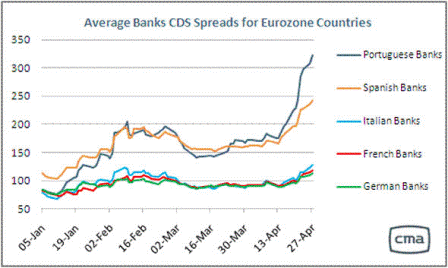
The surging CDS of Portuguese and Spanish banks is a major red flag.
From CMA Datavision:


April 27th, 2010 at 2:16 pm
There is no minimum/maximum limit in TARGET2 – the RTGS payment system. Cross border settlement happens in 30s or so! Intraday credit for banks from their NCBs is free of interest but collateralized. TARGET2 could freeze if a panic spreads.
Reply
jcmccutcheon Reply:
April 27th, 2010 at 3:28 pm
There is no minimum/maximum limit in TARGET2 – the RTGS payment system. Cross border settlement happens in 30s or so! What does this mean? Don’t understand the jargon?
Reply
Ramanan Reply:
April 27th, 2010 at 3:51 pm
Oh that means that any panic could destroy the system in 30s! The banks’ payments system is connected by an electronic system called TARGET2. http://en.wikipedia.org/wiki/TARGET So one can transfer funds within the banking system in a matter of seconds though this real time gross settlement system. In fact the payment system TARGET2 is so good that you can transfer funds between countries with a few seconds. Most countries have a minimum as well as maximum limit on the amount that can be transferred in one shot. TARGET2 has no restrictions.
Reply
April 27th, 2010 at 3:06 pm
“When/if word gets out that depositors can lose, that contagion spreads across the euro zone with a general run on the banking system to actual cash, gold, and other currencies, which doesn’t create a cash shortage but drives the euro down further, and further weakens the credit worthiness of all the national govts.”
That last clause is interesting. It should not weaken the credit worthiness of all the Euro governments, any more than it should weaken the credit worthiness of a federal government (if they had one), but it will, won’t it? :(
There’s another argument for not having a single currency for a weak federation, eh?
Reply
April 27th, 2010 at 3:12 pm
Just heard Trichet is in USA (Chicago) today. Would not comment.
Resp,
Reply
April 27th, 2010 at 3:36 pm
“…which doesn’t create a cash shortage but drives the euro down further…”
People withdrawing savings from banks means banks are loosing reserves, so banks could be forced to deleverage. This should drive the euro up, not down. No?
Reply
zanon Reply:
April 27th, 2010 at 4:17 pm
if people move deposit from one bank to another, then quantity of reserves in whole system is unchanged.
if people are taking euros and using it to buy other things (gold, US$, whatever) then demand for euros compared to other assets is going down, and euro goes down.
Reply
jcmccutcheon Reply:
April 27th, 2010 at 5:28 pm
But what if people put Euro’s under their mattresses. ie. a bank run. Doesn’t this create a route on reserves?
Reply
Ramanan Reply:
April 28th, 2010 at 11:07 am
Zanon,
Yes yes. But it seems Greek banks have been thrown out of the unsecured interbank market and they have to do repos as you said. They can do it as long as they have a good collateral. I am just trying to say that its not necessary for a bank run to happen via people running to their ATMs route. It can happen via electronic transfers because that is quicker. Greek banks will go into overdrafts at the NCBs and may run out of collateral. Of course, there will be people rushing to the ATMs as well. The amount of collateral a bank has is usually less. A lot of banks’ assets are individual illiquid loans which cannot be pledged.
Ramanan Reply:
April 28th, 2010 at 2:24 am
Zanon,
Yes the quantity of reserves is unchanged but a panic can lead to imbalances. If accounts in Greece banks get moved to banks in Germany, Greece banks will suffer. There is no logic about panics – they can occur in unpredictable ways.
If Greek banks run out of collateral, they are toast. They won’t even find unsecured loans in the EURIBOR markets and the Bank of Greece won’t be able to lend them. So there is nothing special about cash.
However, I think something will be done. Unlike the Lehman event, anything of that sort in the EZ has huge social costs. However, I wont bet on this view :)
Reply
zanon Reply:
April 28th, 2010 at 10:21 am
Do not deposits in German banks credit reserve at ECB who can then repo (or whatever) back to Greek bank?
Ramanan Reply:
April 28th, 2010 at 11:10 am
Zanon,
Some issues with the placement of my comments. My reply is above (11:07)
Ramanan Reply:
April 28th, 2010 at 11:33 am
Also, we tend to think of bank runs as people running to the ATMs or bank branches because elecronic transfer takes time. However, the Eurozone seems to have the best payment system in the world. “There is no set minimum amount for a payment made through TARGET2″
Curious Reply:
April 27th, 2010 at 9:03 pm
If banks’ actual and required ratio of loans to reserves is for example 10:1, then for every 1 euro of reserves withdrawn, banks will have to sell (remove from their balance sheets) 10 euros’ worth of loans to be reserve compliant again, no?
If so, then even if people don’t hold their withdrawn euros under their mattresses, but buy gold, etc, for every 1 euro supplied this way to the market, there will be a new demand for 10 euros coming from the banks.
Reply
vipul Reply:
April 27th, 2010 at 9:38 pm
I don’t think so. If someone uses their euro to buy gold, it would return to the banking system in the gold sellers account. Only stuffing euros in mattresses, or burning them, or eating them or something like that would reduce reserves.
Reply
April 27th, 2010 at 10:26 pm
Vipul is correct.
And taking out cash just means the ecb does repos to add the depleted reserves as needed.
until banks run out of eligible collateral, but that should be a long way off
Reply
Jim Baird Reply:
April 28th, 2010 at 8:18 am
Maybe we should get t-shirts printed up that say “Reserves ain’t nothin’ but a number”
Reply
Curious Reply:
May 3rd, 2010 at 12:46 am
In a related story, China raised the required reserves ratio:
http://www.cnbc.com/id/36906702/
Accroding to this discussion, this move by the Chinese cb will accomplish nothing, correct?
Reply
warren mosler Reply:
May 3rd, 2010 at 5:43 am
correct.
however, it says they are moving to curb lending, which can mean ordering the state owned banks to cut back, which does accomplish a lot.
it also confirms the monetarists are at least partially in control
Reply
Tom Hickey Reply:
May 3rd, 2010 at 11:03 am
Fear of property speculation grips Chinese leadership
Reply
zanon Reply:
May 3rd, 2010 at 11:22 am
In China, state directled lending means they have a fiscal policy channel US does not.
China can tell bank to lend knowing loan will never be paid back, and then recapitalize on back end.
China is all accursed with the same economists the US is, reading same texbook.
Reply
April 28th, 2010 at 2:34 am
Makes sense. Thanks.
If the ECB accepts Greek debt as collateral for repos, why doesn’t the ECB start buying Greek debt outright, driving the interest rate down?
Reply
Ramanan Reply:
April 28th, 2010 at 3:32 am
NCBs buying their home country’s government’s debt is not a violation of the Statute of the ESCB but a violation of the spirit. There are many articles – official ones – written by the ECB mentioning this.
The ECB targets the overnight/short term rates only and leaves the markets to decide the long term yields.
Reply
April 28th, 2010 at 9:43 am
Under an international fiat regime, the sovereign problem is always with liquidity, never with solvency, because 1) the difficulties of sovereigns arise from self-imposed rules that can be changed, and 2) CB’s can always create reserves as the llr. Therefore, going down is always a matter of political choice rather than financial necessity. The questions is, therefore, whether staring into the abyss they will pull back or become mesmerized.
Reply
April 28th, 2010 at 10:07 am
I’m a little confused as to why the run on the banks as Warren describes would further weaken the credit-worthiness of ALL of the national governments. I can see that it would weaken some of them, as they would now have insured bank deposits added to their liabities, but can it possibly weaken ALL of them. As Warren points out, the Euros have to go somewhere. They don’t disappear. Yes, the value of the Euro against other currencies and against real assets will decline, but that could end up improving the fiscal situation as tax revenues would increase along with inflation. Exports would also increase, helping to offset the reduced aggregate demand from higher prices and higher tax revenues.
Reply
April 28th, 2010 at 10:13 am
Ramanan, or anyone else. Can someone answer the following query I have.
Banks are required to have an adequate reserve of capital, but when a bank lends to another bank, does it need to have a reserve of capital? I’m not talking about the interbank market here.
If lending between banks doesn’t require a reserve of capital, then the amount of credit banks can create between each other is infinite. Hence, deposits are infinite.
If Bank A lends to a borrower say €10,000.
Bank A—————>Borrower————->Customer———–>Bank B
The borrower gives the €10,000 to a customer of Bank B. After the clearing, Bank A’s reserve account at the CB will be debited by €10,000 and Bank B’s reserve account credited by €10,000. Bank A’s assets have changed i.e. a loan to a customer has increased, and its reserve account decreased. But its balance sheet total is unchanged.
Now assume there is no borrower or customer
Bank A ——————————-> Bank B
loans (Bank A assets) deposits (Bank A liabiities)
Bank A lends to Bank B €10,000. Bank A’s assets have changed i.e. a loan to Bank B, and it’s reserve account has decreased. But its balance sheet is unchanged. In the first example Bank A needed extra capital, but in the second example it didn’t.
The reason I’m asking is that when banks got into trouble, one bank transferred $7.5 billion in deposits to another bank. What were they trying to achieve by doing this?
http://www.angloirishbank.com/Media-Centre/Press_Release_HTML/Clarification_statement_from_Anglo_Irish_Bank_Corporation_Limited_relating_to_transactions_with_Irish_Life_Permanent_plc.html
BFG
Reply
April 28th, 2010 at 10:16 am
Sorry about that link, if someone can change it heres a shorter version.
http://bit.ly/aPInQz
Reply
April 29th, 2010 at 11:48 am
Let me assure everyone that there is no run on Greek banks. Actually, Greek banks announced a 10% rise in deposits during March (367 billion euros or 60% more of GDP! which reflects the fact that the private sector unreports 40% of GDP!). Furthermore, the private sector has outstanding debt equal to 90% of GDP, so total Public+private debt to GDP is about 200%, much less than most other countries which have smaller public debt but much higher private debt as a share of GDP.
Reply