
Posted by WARREN MOSLER on 23rd February 2010
Good chart.
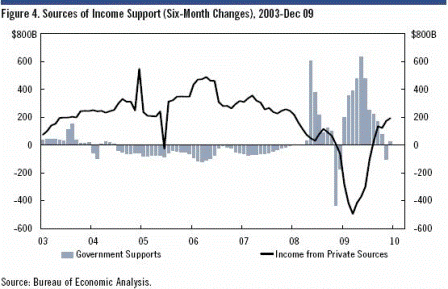
Note how the deficit as a % of GDP began trailing off midway through 06 and brought income from private sources (which for the most part are driven by private sector debt increases) down with it. And how the latest increase in deficit spending has begun to restore it.
As always, taxes function to regulate agg demand and, in fact, don’t actually raise revenue for the federal govt that never has nor doesn’t have any dollars.
It taxes by changing numbers down in our accounts and doesn’t actually get anything, and spends by changing numbers up in our accounts and doesn’t use up anything.
On Tue, Feb 23, 2010 at 9:59 AM, wrote:
Interesting chart from Citi Econ. 6mth rate of change in Income via Govt Support (essentially unemployment benefits, social security, medicare, etc) and Income from Private Sources (mostly wage and salary income, but also corp pension contributions, rental income, interest income, etc).
Posted in Deficit, GDP, Government Spending | 4 Comments »
Posted by WARREN MOSLER on 23rd February 2010
The markets are likely to force some entity to write a check:
EU Headlines:
EU Says There Is No Plan to Bail Out Greece
Provopoulos Confident Greece Will Meet ‘Very Ambitious’ Goals
Euro Worst to Come as Greece Hammerlocks ECB on Rates
German Recovery ‘Prone to Setbacks,’ Finance Ministry Says
French Lawmaker Warns Sarkozy Against Hasty Support for Greece
Five Percent of German Taxpayers Generate 42% of Income Tax
Debt Deals Haunt Europe
Greece Said to Have Arranged Swaps With 15 Banks
Greece looks at tougher budget cuts
Greek PM rules out bailout but urges EU solidarity
EU Says There Is No Plan to Bail Out Greece
Feb. 22 (Bloomberg) — The European Union said there is no plan to bail out Greece.
“There is no such a plan,” EU spokesman Amadeu Altafaj told reporters in Brussels today. “This is a speculative scenario at this point in time.”
“I was reading the papers when I also realized that in fact that there is no such a plan,” Altafaj said. “I think that the extraordinary summit and the Ecofin said all that had to be said on this and there has never been such a request from the Greek authorities and that remains the case.”
Posted in ECB | 1 Comment »
Posted by WARREN MOSLER on 23rd February 2010
He clearly doesn’t distinguish the difference between Germany and the US with regards to interest rate determination and solvency risk:
“It’s very, very hard to call the timing, but it will happen,” Rogoff, co-author of a history on financial calamities, said in the speech. “In rich countries — Germany, the United States and maybe Japan — we are going to see slow growth. They will tighten their belts when the problem hits with interest rates. They will deal with it.”
Posted in Germany, Government Spending | Comments Off
Posted by WARREN MOSLER on 23rd February 2010
In case you thought Shiela Bair understands banking and the monetary system.
All this can do is further reduce aggregate demand.
The entire administration including the Fed and Tsy seems hopelessly mired in gold standard economics.
FOR IMMEDIATE RELEASE
February 22, 2010 Media Contact:
Greg Hernandez (202) 898-6984
Cell: (202) 340-4922
Email: ghernandez@fdic.gov
The Federal Deposit Insurance Corporation (FDIC) is calling upon consumers across the nation during America Saves Week to consider establishing a basic savings account or boosting existing savings. FDIC Chairman Sheila Bair said, “One fundamental lesson of the financial crisis is that savings can help families withstand sudden changes in their economic well being. Establishing a savings account in a federally insured institution is a great first step to build wealth and begin a savings habit that will last a lifetime.”
The personal savings rate rose to 4.6 percent in 2009 from 2.7 percent in 2008, according to the U.S. Department of Commerce. “I am pleased to see that people are saving more of their hard-earned money and building wealth. Having personal savings for an emergency fund or saving for a future expenditure, such as a college education, can make a big difference in avoiding other costly alternatives. I’ve always been a big advocate of a back-to-basics approach to financial services; it’s my hope that Americans’ increase in savings is the beginning of a long-term trend,” Bair said.
“Money saved by consumers also provides a stable source of funding for investments in the economy that benefit all Americans,” said Bair. “In fact, a country with robust savings generally has more capital to fund investments and support economic growth over the long-term. As demonstrated recently, it is harmful to an economy when consumers spend beyond their means, financed by debt that they cannot afford to repay.”
To learn more about America Saves Week and about savings-related resources from the FDIC, please visit http://www.fdic.gov/deposit/deposits/savings.html.
Posted in Banking, Government Spending | 7 Comments »