
Thanks,
More and more evidence that it all started reversing when the great Mike Masters inventory liquidation ended late December as the automatic stabilizers did their thing (the ugly way).
Southland home sales highest since late ’06; median price up again
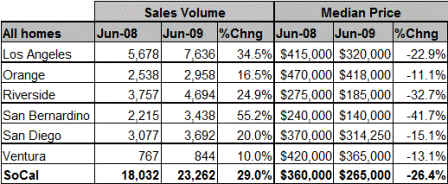
July 15 (DQNews) — La Jolla, CA — Southern California home sales rose in June to the highest level in 30 months as the number of deals above $500,000 continued to climb. June’s sales gain, plus another rise in the region’s median sale price, indicate buyers responded to price cuts on mid- to high-end homes and found it easier to secure financing for pricier abodes, a real estate information service reported.
A total of 23,262 new and resale houses and condos closed escrow in San Diego, Orange, Los Angeles, Ventura, Riverside and San Bernardino counties last month. That was up 12.0 percent from 20,775 in May and up 29.0 percent from a revised 18,032 a year ago, according to San Diego-based MDA DataQuick.
Sales have increased year-over-year for 12 consecutive months.
June’s sales were the highest for that month since 2006, when 31,602 homes sold, but were 17.7 percent below the average June sales total since 1988, when DataQuick’s statistics begin. June sales peaked at 40,156 in 2005 and hit a low last year.
Foreclosures remained a major force in June, but their impact on the resale market eased for the third consecutive month.
Foreclosure resales – homes sold in June that had been foreclosed on in the prior 12 months – represented 45.3 percent of Southland resales last month, down from 49.7 percent in May and down from a peak 56.7 percent in February this year. Last month’s level was the lowest since foreclosure resales were 43.7 percent of resales in July 2008.
As the influence of deeply discounted foreclosures in lower-cost areas has waned in recent months, sales in higher-cost housing markets have increased and accounted for a greater share of total transactions.
Resales of single-family houses priced $500,000 and above rose to 19.6 percent of all existing houses sold in June, up from 18.0 percent in May but still down from 29.2 a year ago. The last time the $500,000-plus market made up more than 19 percent of sales was last October, when it was 19.9 percent. Sales of $500,000-plus houses dipped to as little as 13.4 percent of sales in January this year.
The recent shift toward higher-cost markets contributing more to overall sales has put upward pressure on the region’s median sale price – the point where half of the homes sold for more and half for less. The median dived sharply over the past year not just because of price depreciation but because of a shift toward an unusually large share of sales occurring in lower-cost, foreclosure-heavy areas.
The median price paid for all new and resale houses and condos sold in the Southland last month was $265,000, up 6.4 percent from $249,000 in May but down 26.4 percent from $360,000 a year ago. It was the second consecutive month in which the median rose on a month-to-month basis. Before May’s 0.8 percent increase over April, the median hadn’t risen from one month to the next since July 2007.
Last month’s median was the highest since it was $278,000 last December, but it stood 47.5 percent below the peak $505,000 median reached in spring and summer of 2007.
“The rising median should still be viewed mainly as a sign the market’s moving back toward a more normal distribution of sales across the home price spectrum. Sales in many higher-cost neighborhoods couldn’t have gotten much lower, so this recent uptick in activity should come as no surprise. The recession and problem mortgages are fueling more high-end distress, hence more high-end ‘bargains.’ What’s missing, still, is a wide-open financing spigot for the would-be buyers of these more expensive homes,†said John Walsh, DataQuick president.
There were signs last month that credit was flowing a bit more easily for high-end buyers: The share of Southland purchase loans above $417,000 rose to 14.8 percent in June, the highest since it was 15.6 percent last August. “Jumbo†mortgages needed to buy pricier homes have been more expensive and much harder to obtain since August 2007, when the credit crunch hit. Before then, nearly 40 percent of Southland sales were financed with jumbo loans, then defined as over $417,000.
Bank of America makes the most home purchase loans in Southern California with about 20 percent of the market. Wells Fargo has 10 percent of the market.
In lower-cost “starter†housing markets, many first-time buyers continued to choose government-insured FHA financing. Such loans were used to finance 36.8 percent of home purchases last month, down slightly from 37.4 percent in May but up from 19.7 percent a year ago.
Absentee buyers, including investors who will have their property tax bills sent to a different address, bought 18.6 percent of the Southland homes sold last month. That’s up from 16.1 percent a year ago but down from 19.5 percent in May. The monthly average since 2000: 15 percent. Southland homebuyers appearing in public records with “LLC†in their names, meaning a limited liability company (used by some investor groups), accounted for about 1.5 percent of June home sales (345 sales). That’s down from a high of 2 percent in April but still well above the average of 0.6% of monthly sales this decade.
The year-ago numbers for Orange County and the region have been revised to include a late data update.
The typical monthly mortgage payment that Southern California buyers committed themselves to paying was $1,193 last month, up from $1,052 the previous month, and down from $1,762 a year ago. Adjusted for inflation, current payments are 46.0 percent below typical payments in the spring of 1989, the peak of the prior real estate cycle. They are 55.7 percent below the current cycle’s peak in July 2007.
Indicators of market distress continue to move in different directions. Foreclosure activity remains near record levels, while financing with adjustable-rate mortgages is near the all-time low but has recently edged higher. Financing with multiple mortgages is low, down payment sizes and flipping rates are stable, and non-owner occupied buying is above-average in some markets, MDA DataQuick reported.

[top]