JFK on government, secrecy, and the press
[top]

This selling of land is a directly deflationary/contractionary policy, and all because they think the government needs the funds.
Japan’s MOF land sales faltering
May 17 (Nikkei) — The Ministry of Finance is having trouble selling public land, even in metropolitan Tokyo, amid deterioration of Japan’s real estate market in the wake of the global financial crisis.
Market sluggishness is complicating MOF plans to raise funds for fiscal rehabilitation through sale of such land, including properties acquired as in-kind tax payments, with a series of auctions drawing no bidders.
Last December, the ministry planned to sell a huge parcel of 7.7 hectares in a coastal area of Chiba. Some condominium developers had expressed interest in the property during a pre-auction briefing.
But the MOF, which manages public land, called off the auction at the last moment, realizing that no bid would be made.
The Chiba lot holds some 1,300 abandoned apartments which previously housed government workers, but have remained vacant since March 2006.
As recently as 2007, real estate developers flocked to build condos on available land in a competitive wave extending to Chiba. At that time, the vast coastal property, a rare offering, could have sold “on the spot,” said an official involved in the canceled auction.
Government-own plots often sell well because their titles are usually free of unsettled claims. This is especially the case in big cities and their surrounding areas, which contain active real estate markets.
But there remains a scarcity of buyers because the global economic downturn has forced many financial institutions to curtail financing of real estate deals.
In recent MOF auctions, the ratio of successful offers in Tokyo’s 23 wards plunged to just above 50% in the second half of fiscal 2007 from 100% in the first half. And the ratio fell to nearly 30% in the first half of fiscal 2008 and 24% in the second half.
A plan worked out by the ministry in 2007 envisions raising 2.1 trillion yen by the end of fiscal 2015 through the sale of public assets, such as vacant land like the lot in coastal Chiba. The proceeds would be used to finance fiscal rehabilitation.
But a substantial delay in implementation appears unavoidable due to the weakness of the property market.
Private-sector auctions often resort to “bulk sales” to stimulate demand for unpopular parcels of land by combining them with lots expected to draw strong demand. The ministry does not have this option, as government-owned lots must be sold at “fair prices” under the public finance law.
Another reason for the difficulty in attracting buyers is that the ministry is eager for higher-priced deals and often “lacks flexibility,” says a real-estate appraiser.
Prolonged vacancies of public land may not only depress the local real estate market, but also cause security problems in some cases. In addition, the government’s cost of managing unused properties continues to escalate.
When an advisory panel to the finance minister convened in late February to discuss the sale of public land, MOF officials complained they are caught in a catch-22 — raising sorely needed funds through property sales is a thorny process amid real estate market conditions that continue to deteriorate.
(The Nikkei May 15 morning edition)
[top]
(email exchange)
> On Fri, May 15, 2009 at 9:22 AM, wrote:
> Hi Warren. Roubini (the contemporary Dr. Doom) is suggesting this morning that
> the Chinese currency should be the new global reserve currency.
>
> Don’t you need a country that runs an external payments deficit (or at least not a
> surplus)?
Helps a lot! Unless someone out there wants to get short your currency so everyone else can get long!
> that also has deep and unrestricted capital markets?
At least not restricted to the point no one else can hold financial assets denominated in your currency.
The other big thing that helps is that they all want to export to you.
The word ‘reserve currency’ has come to mean others use it as their fx reserves?
If so, they first must want to have fx reserves, and the usual reason for that is to support their exporters to the region of the ‘reserve currency.’
So he’s saying China is scheming to be a major net importer? Doubt it, though that’s what I would do if I were them.
[top]
Central bank liquidity swaps (13) 246,500 – 2,802
It’s for real – Obama’s in the deficit terrorist camp, using the communication skills he learned in his rhetoric 101 class.
Obama Says U.S. Long-Term Debt Load ‘Unsustainable’
by Roger Runningen and Hans Nichols
May 14 (Bloomberg) — President Barack Obama, calling current deficitspending “unsustainable,†warned of skyrocketing interest rates for consumers if the U.S. continues to finance government by borrowing from other countries.
“We can’t keep on just borrowing from China,†Obama said at a town-hall meeting in Rio Rancho, New Mexico, outside Albuquerque. “We have to pay interest on that debt, and that means we are mortgaging our children’s future with more and more debt.â€
That’s a load of inapplicable rhetoric for the purpose of terrorizing uninformed Americans.
Holders of U.S. debt will eventually “get tired†of buying it, causing interest rates on everything from auto loans to home mortgages to increase, Obama said. “It will have a dampening effect on our economy.â€
Interest rates are set by the Fed, not by those who elect to buy Treasury securities.
The president pledged to work with Congress to shore up entitlement programs such as Social Security and Medicare and said he was confident that the House and Senate would pass health-care overhaul bills by August.
“Most of what is driving us into debt is health care, so we have to drive down costs,†he said.
Whatever costs he’s got in mind (insurance, drug company markups, etc.) should be minimized in any case.
It’s not about the ‘debt’.
The biggest risk to our economy is the risk of Obama succeeding in enacting measures to reduce the deficit.
[top]
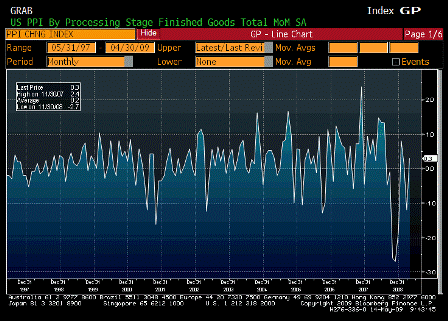


| Survey | 0.2% |
| Actual | 0.3% |
| Prior | -1.2% |
| Revised | n/a |
Karim writes:
PPI
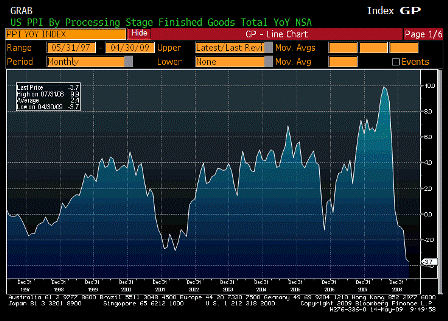
| Survey | -3.7% |
| Actual | -3.7% |
| Prior | -3.5% |
| Revised | n/a |
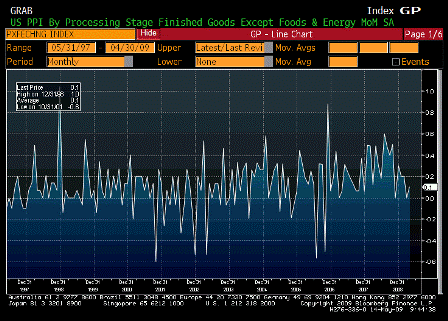
| Survey | 0.1% |
| Actual | 0.1% |
| Prior | 0.0% |
| Revised | n/a |
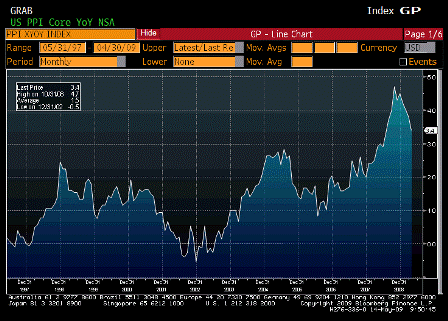
| Survey | 3.4% |
| Actual | 3.4% |
| Prior | 3.8% |
| Revised | n/a |
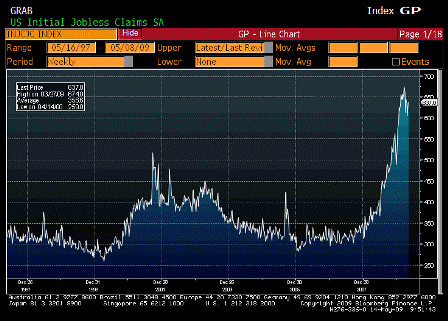
| Survey | 610K |
| Actual | 637K |
| Prior | 601K |
| Revised | 605K |
Karim writes:

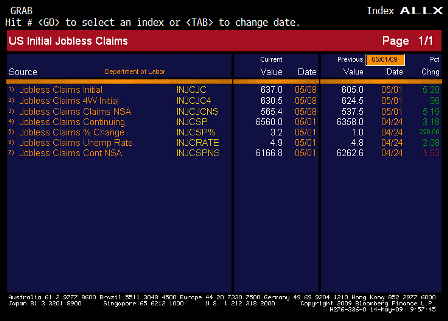
| Survey | 6400K |
| Actual | 6560K |
| Prior | 6351K |
| Revised | 6358K |
[top]