Re: A message from Prof. Auerbach


[Skip to the end]

(email exchange)

Robert has it wrong.

There are excess reserves because the Fed has decided to not do what it used to do, sell or ‘reverse out’ its securities to offset operating factors that caused reserves to increase.

These operating factors include Fed purchases of securities.

The reason the Fed would ‘drain’ excess reserves was to keep the interest rate at its target rate.

By paying interest on reserves it can accomplish that without selling its securities.

Reserves are functionally one day securities, as all treasury securities are nothing more than deposits at the Fed anyway.

And previous concerns about the Fed running out of securities were also addressed by being able to pay interest on reserves.

The idea that banks hold reserves (for any reason) ‘instead’ of lending is nonsensical.

All that paying interest on reserves does regarding lending behavior is increase the rates banks might charge for loans.

As always regarding the Fed, it’s about price, not quantity.

With a 0% interest rate policy interest on reserves discussions are moot anyway.

> &#160 
> &#160 J wrote:
> &#160 
> &#160 Auerbach’s idea: stop paying interest on reserves. What do you think? J
> &#160 

Where’s the Stimulus

by Jim McTague

Feb 2 (Barrons) — University of Texas Professor Robert Auerbach, an economist who studied under the late Milton Friedman, thinks he has the makings of a malpractice suit against Federal Reserve Chairman Ben Bernanke, as the Fed is holding a record number of reserves: $901 billion in January as opposed to $44 billion in September, when the Fed began paying interest on money commercial banks parked at the central bank. The banks prefer the sure rate of return they get by sitting in cash, not making loans. Fed, stop paying, he says.


[top]
Re: Niall Ferguson in the FT


[Skip to the end]

(email exchange)

They’ve all forgotten imports are a real benefit, exports a real cost, so they are afraid that imports will go up if you make a fiscal adjustment unilaterally.

In fact, it’s the best of all worlds to do it unilaterally and let the imports flood in.

To paraphrase Nixon (?):

‘They are all half baked Keynesians now’.

>   
>   On Mon, Feb 2, 2009 at 9:53 PM, MAuer wrote:
>   
>   Any thoughts on this?
>   
>   Subject: Niall Ferguson in the FT
>   
>   Today’s born-again Keynesians seem to have forgotten that their prescription
>   of a deficit-financed fiscal stimulus stood the best chance of working in a more
>   or less closed economy. But this is a globalised world, where uncoordinated
>   profligacy by national governments is more likely to generate bond market
>   and currency market volatility than a return to growth.
>   


[top]

Outlook from a blog reader/fund manager


[Skip to the end]

Outlook:

One month into 2009 – a new president installed in office – yet no more clarity. In fact more questions than answers.

After criticizing Hoover in the 1932 election for running deficits (sound familiar?), President Franklin Roosevelt tried diligently for six years to balance the budget and resuscitate the economy at the same time. It did not work. Then, willing to try anything after more than five years of failure, FDR said in one of his fireside chats in 1938, “We suffer primarily from a failure of consumer demand because of a lack of buying power. Therefore it is up to [the government] to create an economic upturn” by making “additions to the purchasing power of the nation.” This reluctant realization alone was not enough to pull the U.S. economy from the depths of the Great Depression. It took entry into World War II to drive deficit spending high enough such that GDP more than doubled in five years as unemployment declined from an estimated 18% to roughly 1%.

Today we find ourselves in a similar situation. The surpluses of the late 1990’s withdrew financial assets from the U.S. economy that were temporarily replaced from 2001-2007 by loose lending standards, house price appreciation, and mortgage equity withdrawal. When house prices began to roll over near the end of 2006, the U.S. economy needed a budget deficit that was large enough to offset the cumulative deleterious effects of the late 1990’s surpluses. This of course did not happen, and the situation has deteriorated as the diminution in aggregate demand has cycled in a vicious feedback loop with weaker economic data, a weaker banking system, and rising unemployment.
We had very high hopes for the Obama stimulus plan, and we still very much hope that it will work; but we are concerned that it is neither large enough nor swift enough to offset the contractionary forces we are facing.

From an economic perspective, it is not important if the stimulus occurs through additional spending or cutting taxes, it just needs to happen quickly. The recently-passed version of the stimulus seems short on rapid infrastructure spending and tax cuts, and long on pet projects and politically-driven initiatives. We recognize that many interested parties who view themselves as “conservative” are frustrated by what they view as fiscal incontinence by Washington. We agree that pet projects and deferred earmarking add viscosity to the stimulus effort, but nonetheless the spending and/or tax breaks need(s) to occur. Only the U.S. government has the balance sheet to offset the contractionary forces we are facing. We are fortunate that automatic stabilizers, such as lower tax revenues and expanding transfer payments, are more difficult for Washington to manipulate. It will be quite interesting to see the final shape and efficacy of the stimulus package. Our fingers are crossed that the stimulus in its final form plus the automatic stabilizers will foster aggregate demand large enough to break the back of this contraction. Equity markets will be watching closely.

Thank you for your continued support. I am always available to discuss our performance and portfolio.

Best regards,
Josh Davis


[top]

2009-02-03 USER


[Skip to the end]


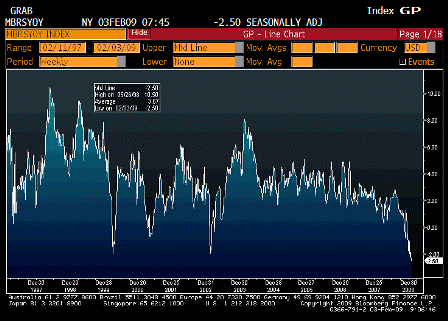
ICSC UBS Store Sales YoY (Feb 3)

Survey n/a
Actual -2.50%
Prior -2.40%
Revised n/a

[top][end]

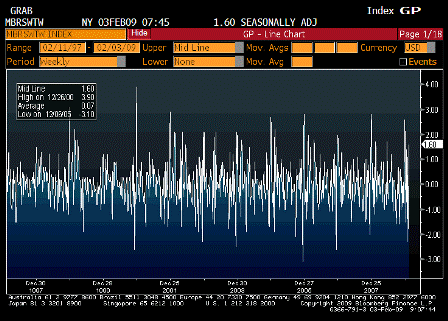
ICSC UBS Store Sales WoW (Feb 3)

Survey n/a
Actual 1.60%
Prior -1.80%
Revised n/a

[top][end]

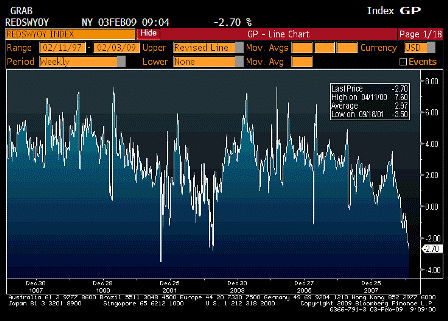
Redbook Store Sales Weekly YoY (Feb 3)

Survey n/a
Actual -2.70%
Prior -2.30%
Revised n/a

[top][end]

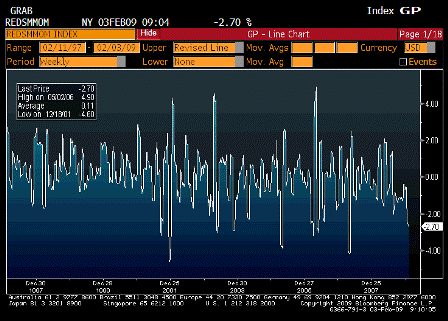
Redbook Store Sales MoM (Feb 3)

Survey n/a
Actual -2.70%
Prior -2.60%
Revised n/a

[top][end]

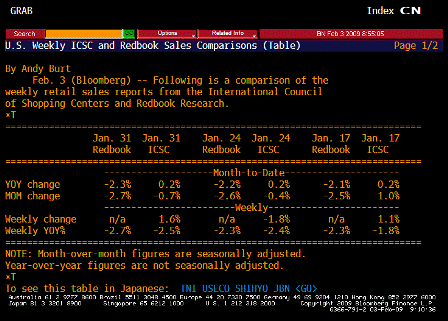
ICSC UBS Redbook Comparison TABLE (Feb 3)

[top][end]

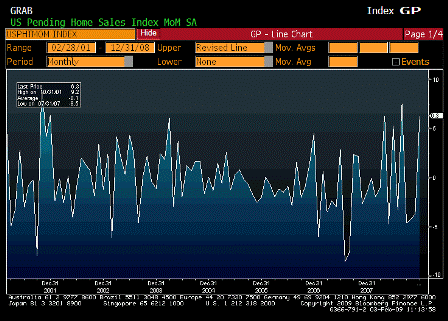
Pending Home Sales MoM (Dec)

Survey 0.0%
Actual 6.3%
Prior -4.0%
Revised -3.7%

[top][end]

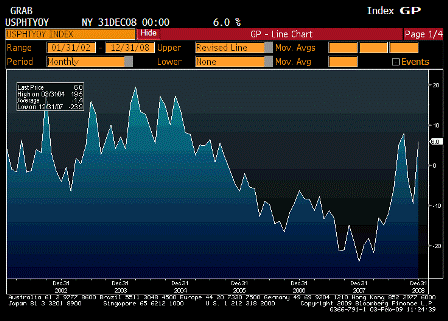
Pending Home Sales YoY (Dec)

Survey n/a
Actual 6.0%
Prior 9.5%
Revised n/a

 
Chewing through the foreclosures.


[top]