Posted by WARREN MOSLER on 30th January 2009
[Skip to the end]
A rising criticism is that the Obama proposal has no exit strategy.
The Obama proposal IS the exit strategy from falling output and rising employment.
The target is the economy.
Fiscal policy is the tool to hit the target.
The mainstream notion of an exit strategy from budget deficits demonstrates a profound misconception about fiscal policy.
The right size for the Federal budget deficit is any size that supports output and employment.
Only government deficit spending can provide the equity/savings of financial assets needed to sustain aggregate demand.
Government finance has no solvency issue, and no sustainability issue.
All government spending is nothing more than data entry on the government’s own spread sheet.
Government spending does not ‘have to come from’ somewhere-
- Government borrowing does not take away savings.
- Treasury securities ARE savings that are added to total savings by government deficits.
Government spending is not operationally constrained by revenues.
Government policy that restricts our available savings by keeping the deficit too small depresses output and employment.
Increasing the deficit when the output gap is too large removes the fiscal drag that is depressing output.
The Obama plan is best thought of as removing fiscal restriction, not ‘adding stimulus’.
It is a step in the right direction, but probably insufficient to restore output and employment to even moderate levels.
If the President or any of his immediate advisors understood monetary operations and reserve accounting we would have seen a very different proposal, and seen it much sooner.
[top]
Posted in Obama | 9 Comments »
Posted by WARREN MOSLER on 30th January 2009
[Skip to the end]
Karim writes:
In my years of following G7 economies, I have never seen weaker data than we have had in Japan in recent months.
Today’s data:
- Industrial production -9.6% in December (record monthly fall), following up on -8.5% m/m in November and industry projecting -9.1% in January.
- Moreover, the ratio of inventories to shipments rose 6.5% for the month and is now up 33.5% yr/yr.
- Tokyo Core CPI also went back into negative territory in January (-0.3% yr/yr).
- The weakness in manufacturing thus far reflects the collapse in demand from China and the U.S. (exports down 35% yr/yr).
- As production cuts lead to higher layoffs, the next leg down will be in private consumption.
- Most dealers are now forecasting back to back -10% quarters for real GDP in Q4 and Q1.
- With the current government on the ropes and April legislation that may lead the yen even stronger, the prognosis past Q1 doesn’t appear very good.
[top]
Posted in Japan, Karim | No Comments »
Posted by WARREN MOSLER on 30th January 2009
[Skip to the end]
>
> On Thu, Jan 29, 2009 at 8:52 PM, Russell wrote:
>
Jan 29 (Reuters) — Goldman Sachs estimated that it would take on the order of $4 trillion to buy troubled mortgage and consumer debt. That number could shrink if the program were limited to only certain loans or banks, but it could also grow if other asset classes such as commercial real estate loans were included.
That would also shrink if there was a payroll tax holiday and the states were given $300 billion on a per capita basis as delinquencies would subside and asset quality restored.
This problem is best addressed from the bottom up by enhancing the income of borrowers, not from the top down by assisting the lenders.
The Wall Street Journal said government officials had discussed spending $1 trillion to $2 trillion to help restore banks to health, citing people familiar with the matter….
The government would not necessarily have to spend the full $4 trillion to buy the assets. If it follows the model used in a Federal Reserve program to support consumer and small business loans, the government could potentially put up just 10 percent of the total.
[top]
Posted in Articles | 3 Comments »
Posted by WARREN MOSLER on 30th January 2009
[Skip to the end]


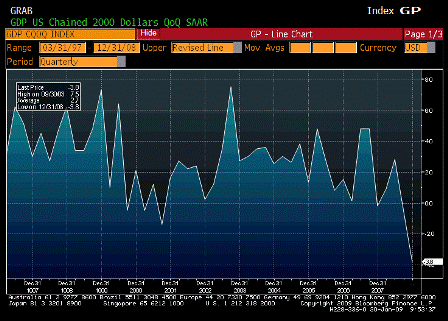
GDP QoQ Annualized (4Q A)
| Survey |
-5.5% |
| Actual |
-3.8% |
| Prior |
-0.5% |
| Revised |
n/a |
Karim writes:
Better than expected at -3.8% due to inventory build.
Here is the GDP math:
Private consumption (-2.5%) + Business Fixed Investment (-3.1%) + Government (+0.4%) + Net Exports (+0.1%) + Chg in Inventories (+1.3%)
- Real final sales of -5.1% were consistent with estimates.
- Business sector overestimated domestic demand, thereby accounting for the inventory build (should reverse in Q1).
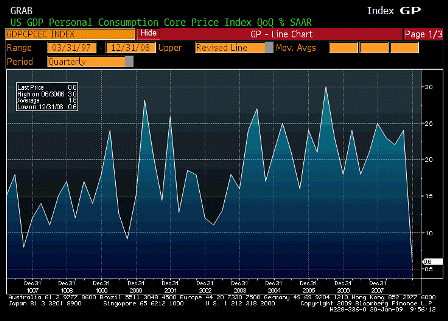
- Core PCE deflator slowed from 2.4% to 0.6%.
- Within investment, both housing (-23.6%) and equipment/software (-27.8%) were very weak.
[top][end]


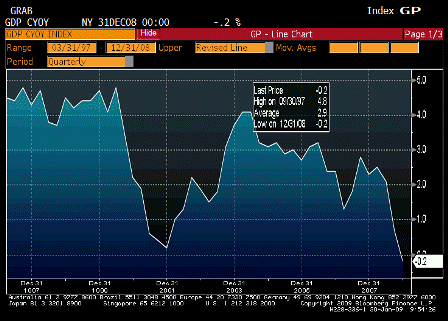
GDP YoY Annualized Real (4Q A)
| Survey |
n/a |
| Actual |
-0.2% |
| Prior |
-0.7% |
| Revised |
n/a |
[top][end]


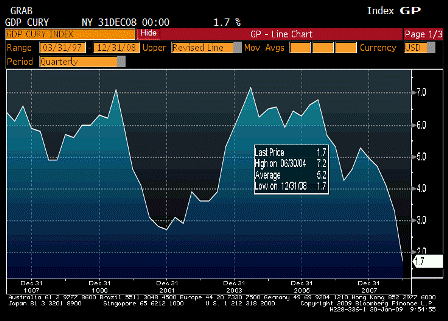
GDP YoY Annualized Nominal (4Q A)
| Survey |
n/a |
| Actual |
1.7% |
| Prior |
3.3% |
| Revised |
n/a |
[top][end]


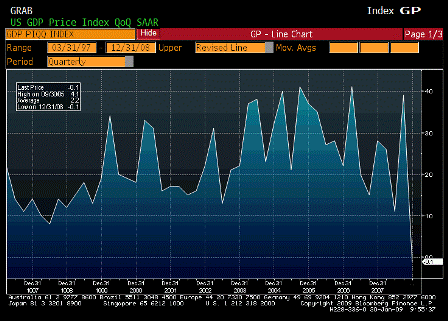
GDP Price Index (4Q)
| Survey |
0.4% |
| Actual |
-0.1% |
| Prior |
3.9% |
| Revised |
n/a |
[top][end]


Core PCE QoQ (4Q)
| Survey |
1.0% |
| Actual |
0.6% |
| Prior |
2.4% |
| Revised |
n/a |
[top][end]


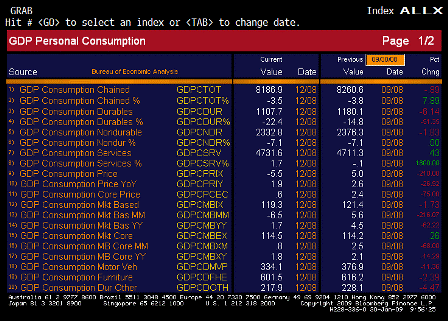
GDP ALLX 1 (4Q)
[top][end]


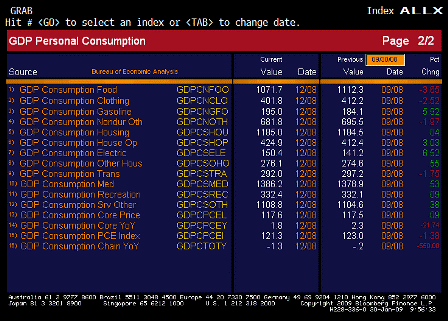
GDP ALLX 2 (4Q)
[top][end]


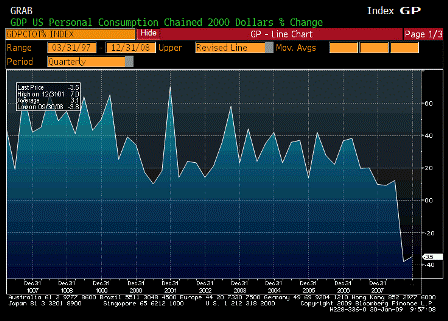
Personal Consumption (4Q)
| Survey |
-3.5% |
| Actual |
-3.5% |
| Prior |
-3.8% |
| Revised |
n/a |
[top][end]


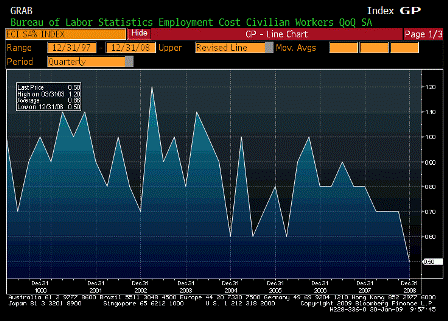
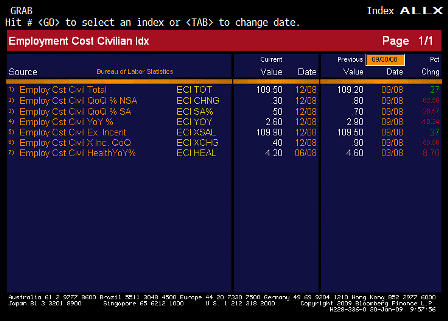
Employment Cost Index (4Q)
| Survey |
0.7% |
| Actual |
0.5% |
| Prior |
0.7% |
| Revised |
n/a |
[top][end]


Employment Cost Index ALLX (4Q)
[top][end]


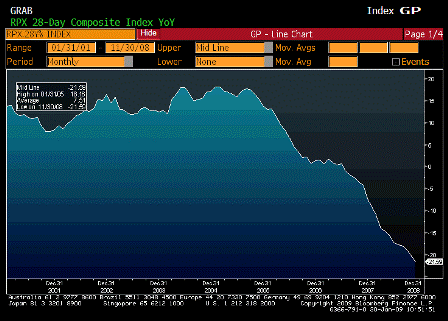
RPX Composite 28dy YoY (Nov)
| Survey |
n/a |
| Actual |
-21.59% |
| Prior |
-20.14% |
| Revised |
n/a |
[top][end]


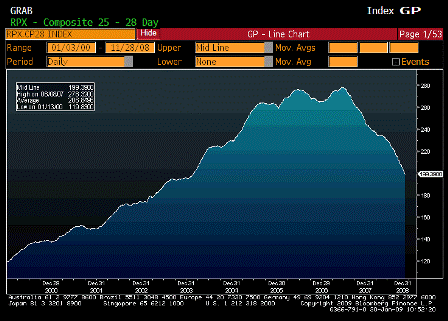
RPX Composite 28dy Index (Nov)
| Survey |
n/a |
| Actual |
199.39 |
| Prior |
206.73 |
| Revised |
n/a |
[top][end]


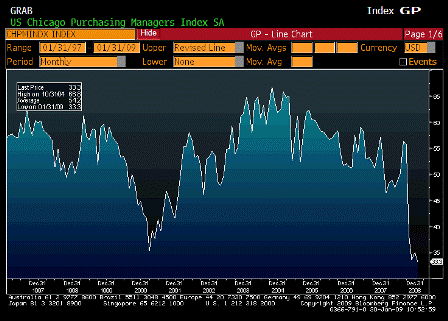
Chicago Purchasing Manager (Jan)
| Survey |
34.9 |
| Actual |
33.3 |
| Prior |
34.1 |
| Revised |
35.1 |
[top][end]


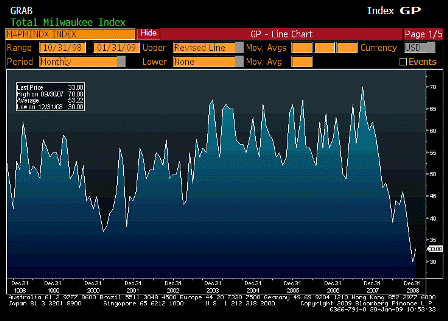
NAPM Milwaukee (Jan)
| Survey |
n/a |
| Actual |
33.0 |
| Prior |
30.0 |
| Revised |
n/a |
[top][end]


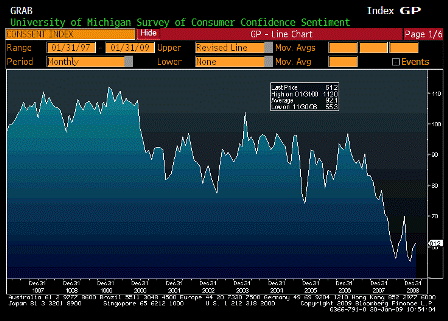
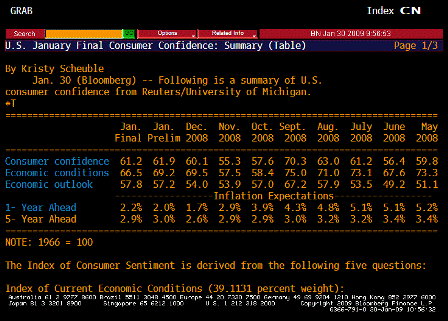
U of Michigan Confidence (Jan F)
| Survey |
61.9 |
| Actual |
61.2 |
| Prior |
61.9 |
| Revised |
n/a |
[top][end]


U of Michigan TABLE Inflation Expectations (Jan F)
[top]
Posted in Daily | No Comments »