Posted by WARREN MOSLER on 5th January 2009
[Skip to the end]
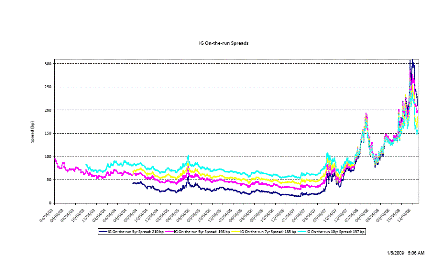
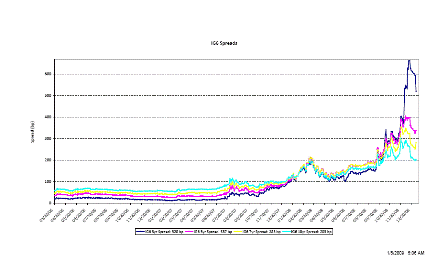
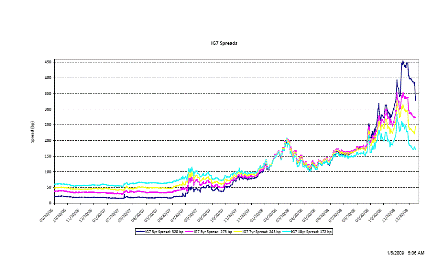
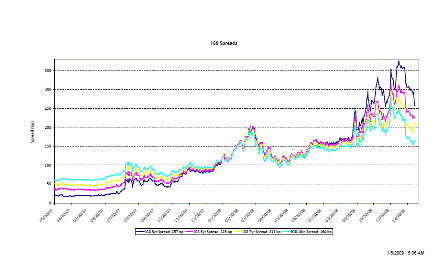
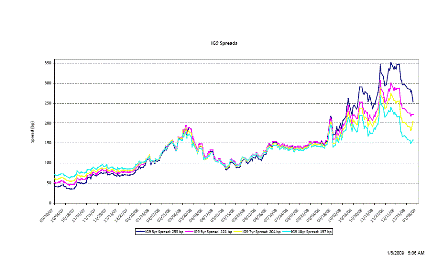
Spreads continue to come in, offering continued support for world equity markets.


IG On-the-run Spreads (Jan 05)
[top][end]


IG6 Spreads (Jan 05)
[top][end]


IG7 Spreads (Jan 05)
[top][end]


IG8 Spreads (Jan 05)
[top][end]


IG9 Spreads (Jan 05)
[top]
Posted in Credit | No Comments »
Posted by WARREN MOSLER on 5th January 2009
[Skip to the end]
Very good, thanks, looks like they’ve come a long way- still some rough edges, but not all that bad for this kind of organization!
Isn’t John Lipsky the head honcho there? We used to have long discussions about exactly this several years ago.
EXECUTIVE SUMMARY
The current crisis calls for two main sets of policy measures. First, measures to repair the financial system. Second, measures to increase demand and restore confidence. While some of these measures overlap, the focus of this note is on the second set of policies, and more specifically, given the limited room for monetary policy, on fiscal policy. The optimal fiscal package should be timely, large, lasting, diversified, contingent, collective, and sustainable: timely, because the need for action is immediate; large, because the current and expected decrease in private demand is exceptionally large; lasting because the downturn will last for some time; diversified because of the unusual degree of uncertainty associated with any single measure; contingent, because the need to reduce the perceived
probability of another “Great Depression” requires a commitment to do more, if needed; collective, since each country that has fiscal space should contribute; and sustainable, so as not to lead to a debt explosion and adverse reactions of financial markets. Looking at the
content of the fiscal package, in the current circumstances, spending increases, and targeted tax cuts and transfers, are likely to have the highest multipliers. General tax cuts or subsidies, either for consumers or for firms, are likely to have lower multipliers.
>
> On Fri, Jan 2, 2009 at 6:37 PM, Roger wrote:
>
> Hi Warren,
>
> Not sure if you saw this, but thought you’d be
> interested.
>
> Best,
> Roger
>
[top]
Posted in Articles | 1 Comment »
Posted by WARREN MOSLER on 5th January 2009
[Skip to the end]
(email exchange)
And this is even worse than the conservation motive:
“Motorists are driving less and buying less gasoline, which means fuel taxes aren’t raising enough money to keep pace with the cost of road, bridge and transit programs.
That has the federal commission that oversees financing for transportation talking about increasing the federal fuel tax.
A 50 percent increase in gasoline and diesel fuel taxes is being urged by the commission to finance highway construction and repair until the government devises another way for motorists to pay for using public roads. “
>
> On Fri, Jan 2, 2009 at 12:39 PM, Deep wrote:
>
> Hi Warren, Karim,
>
> I heard talk of a possible gas tax to make
> consumers change habits / retain the good
> ones gained over the last 6 months.
>
> It sounds like they want to keep price of gas
> at the pump high either directly by Crude
> being high (increase in demand, decrease in
> supply) or through these artificial measures
> and thus force a change in Oil consumption
> patterns. If implemented I can only see
> negative impacts over the 6m timeframe -
>
> a) crimp consumption further by removing $
> from the consumer
>
> b) hurt US Car manufacturer jobs whose
> bottom line seems more leveraged to high gas
> prices than foreign manufacturers
>
> c) accelerate headline inflation possibly forcing
> the Fed to tighten
>
Yes, and worse. Using a gas tax to allocate by price is highly regressive. It means the upper income Americans can have any size SUV they want for safety and prestige and drive all they want, while lower income Americans have to car pool to work in tiny cars.
Seems a Democratic administration would not use allocation (rationing) by price but instead use other, non regressive means of allocation.
Either the Dems don’t know any better or they are now controlled by upper income Americans as the Reps are?
>
> All this, together with a delayed fiscal package
> will likely hit any recovery in consumption.
>
Yes, it would mean we need a larger fiscal package. But not so large to allow all to afford the new gas tax.
>
> Would love to get your thoughts.
>
Seems the political logic remains convoluted, at best!
>
> Thanks, Deep
>
[top]

Posted in Email, Obama | 4 Comments »
Posted by WARREN MOSLER on 5th January 2009
[Skip to the end]
(email exchange)
Right, just as prices are moving up anyway?
Gasoline demand is barely down now, and seems to have gone up over the last month or so?
Funds are buying/rebalancing to keep their allocation at a given % as crude underperformed last year?
OPEC cuts are real as Saudis move to regain control of price as the Masters Inventory Liquidation (finally!) winds down?
The contango in crude is moderating some indicating undesired inventory is fading?
Lower prices have also reduced prospects of new, high cost, supply coming online?
>
> On Fri, Jan 2, 2009 at 11:24 PM, Russell wrote:
>
> Saw that today. Sure took their time. I think it
> will take oil prices higher.
>
Thanks, was wondering when they’d get around to it.
It only has room for another 25 million barrels, however,
>
> On Fri, Jan 2, 2009 at 3:32 PM, EDWARD
> wrote:
>
Congressional Prohibition on Filling Strategic Reserve Ran Out
WASHINGTON (MMNI) – The following is an announcement by the U.S. Department of Energy published Friday:
Oil Acquisition Slated for 2009
WASHINGTON, DC — The U.S. Department of Energy today announced
that it plans to take advantage of the recent large decline in crude oil
prices, and has issued a solicitation to purchase approximately 12 million barrels of crude oil for the nation’s Strategic Petroleum Reserve (SPR) to replenish SPR supplies sold following hurricanes Katrina and Rita in 2005.
In addition, DOE is also moving forward with three other SPR
acquisition and/or fill activities in order to fill the SPR as Congress
directed in the 2005 Energy Policy Act (EPAct): refiner repayments of
SPR emergency oil releases following Hurricanes Gustav and Ike; the
delivery of deferred royalty-in-kind (RIK) oil; and the solicitation of
new RIK deliveries in the spring of 2009.
About the SPR:
Currently, the SPR has a storage capacity of 727 million barrels and an
inventory of 702 million barrels (97%) stored in the SPR’s underground
salt caverns located along the Gulf Coast of Louisiana and Texas.
Activities to resume SPR fill are taken in accordance with the
provisions of the Energy Policy Act (EPAct) of 2005, which directs that
DOE fill the SPR to its authorized capacity of one billion barrels, and
advances the President’s agenda to increase the Nation’s energy
security.
[top]
Posted in Articles, Oil | No Comments »
Posted by WARREN MOSLER on 5th January 2009
[Skip to the end]


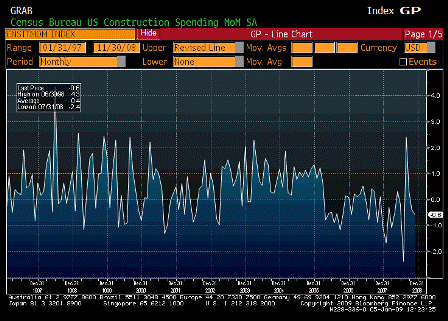
Construction Spending MoM (Nov)
| Survey |
-1.4% |
| Actual |
-0.6% |
| Prior |
-1.2% |
| Revised |
-0.4% |
A little better than expected but still down.
[top][end]


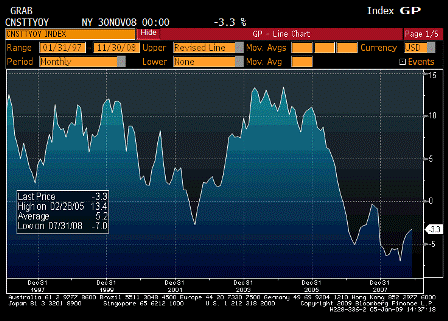
Construction Spending YoY (Nov)
| Survey |
n/a |
| Actual |
-3.3% |
| Prior |
-3.5% |
| Revised |
n/a |
[top]
Posted in Daily | No Comments »