Archive for October, 2008
Posted by WARREN MOSLER on 24th October 2008
[Skip to the end]
Yes, getting closer. The eurozone could be first.
All due to errant political responses.
This did not have to happen.
Operationally it’s a simple matter for governments to spend their way out of it.
The problem is political, mainly due to ignorance of monetary operations and how a non-convertible currency functions.
By Ben Sills and Amanda Ross-Thomas
Oct. 24 (Bloomberg) — New York University Professor Nouriel Roubini said the suspension of U.S. futures trading today shows his prediction that financial markets will be shut down amid panic selling is coming true.
“This morning, even before the markets in the U.S. opened, the S&P futures fell by more than their daily limit,” resulting in futures trading being halted, Roubini told a conference in Madrid today. “What I said yesterday has already started.”
Roubini said yesterday that policy makers may need to shut down financial markets for a week or two as investors dump more assets. In July 2006 he predicted the financial crisis and in February this year he forecast a “catastrophic” meltdown that central bankers would fail to
prevent, leading to the bankruptcy of large banks exposed to mortgages and a “sharp drop” in equities.
Roubini said today that the risks of a “multi-year economic stagnation” in the U.S. are increasing. “Things are getting worse, they are not getting better,” he said. “There’s a growing risk of something worse, an L-shaped recession.”
Roubini, a former senior adviser to the U.S. Treasury Department, said earlier this month that the world’s biggest economy will suffer its worst recession in 40 years.
[top]
Posted in Articles | 9 Comments »
Posted by WARREN MOSLER on 24th October 2008
[Skip to the end]
(email exchange)
Yes! And it’s deep- Hungarian homeowners borrowed yen to buy their homes, for just one example.
And with Japan an importer of all its crude, lower prices make yen that much harder to get, much like USD. And maybe even more so.
>
> On Fri, Oct 24, 2008 at 9:17 AM, James wrote:
>
> Liquidation of Yen carry trades also in full force…..
>
[top]
Posted in Asia, Currencies | 2 Comments »
Posted by WARREN MOSLER on 24th October 2008
[Skip to the end]
I take this as a signal that the Saudis (and probably Russians as they just met with the Saudis) have decided to hold or raise prices and let quantity sold adjust.
Fuel prices are low enough to restore growth in demand with any positive economic performance.
Oct. 24, 2008
The Organization of Petroleum Exporting Countries decided to make a deep cut in oil production, taking 1.5 million barrels a day off global markets as it embarks on the task of managing prices amid a potential global recession.
December light, sweet crude oil futures fell $3.34 to $64.50 a barrel in electronic trading on the New York Mercantile Exchange by midday in London.
[top]
Posted in Oil | 2 Comments »
Posted by WARREN MOSLER on 24th October 2008
[Skip to the end]
Thailand Proposes Asia Pool $350 Billion for Crisis
Not a good sign that they think they need that much in USD. Looks like they are too strung out on USDs.
[top]
Posted in Articles, Asia | No Comments »
Posted by WARREN MOSLER on 24th October 2008
[Skip to the end]
By Craig Torres
Oct. 23 (Bloomberg) — Federal Reserve officials are likely to bring interest rates down so aggressively over the next few months that they will have to search for fresh tactics to continue easing credit.
All that’s left is the Fed buying longer term treasury securities to attempt to flatten the curve, get mortgage rates down, and add reserves.
This will ‘flood the market’ with reserves that now pay interest, so they can do this without a zero interest rate policy.
Their theory is that with more reserves banks will lend more, which is not the case, both in theory and practice, as Japan proved not long ago.
Instead of the Fed buying long term securities the treasury should simply stop issuing them and issue more bills. The treasury not issuing longer term securities is functionally the same as the treasury issuing them and then the Fed buying them. But with a lot fewer transaction costs.
[top]
Posted in Articles, Credit, Fed | 6 Comments »
Posted by WARREN MOSLER on 24th October 2008
[Skip to the end]
Ironically (?) after reading all the criticism of private sector lenders relying on ratings agencies rather than internal analysis I see this:
By Rachel Layne and Scott Lanman
The Fed is setting up the special fund to buy commercial paper, and will start the program on Oct. 27. The U.S. Treasury will make a $50 billion deposit into the fund as an indication of support. The Fed said the maximum amount of commercial paper that could be funded by the facility is about $1.8 trillion.
The central bank will buy only debt with the top short-term ratings of A-1, F1 and P-1 given by Standard & Poor’s, Fitch Ratings and Moody’s Investors Service respectively. The facility provides for 90-day borrowing which may help lengthen the time periods for which liquidity is available.
[top]
Posted in Credit, Fed | No Comments »
Posted by WARREN MOSLER on 24th October 2008
[Skip to the end]
I was just sent this:
External debt (%of GDP)
| Asia 1997 |
Total |
| Thailand |
62% |
| Malaysia |
52% |
| Indonesia |
42% |
| South Korea |
34% |
| Central/Eastern Europe |
Today |
| Latvia |
135% |
| Estonia |
114% |
| Hungary |
102% |
| Croatia |
96% |
| Bulgaria |
90% |
| Ukraine |
53% |
| Poland |
47% |
| Romania |
43% |
| Czech |
40% |
| Lithuania |
40% |
| Turkey |
34% |
[top]
Posted in ECB | No Comments »
Posted by WARREN MOSLER on 24th October 2008
[Skip to the end]


Existing Home Sales (Sep)
| Survey |
4.95M |
| Actual |
5.18M |
| Prior |
4.91M |
| Revised |
n/a |
A little surprise blip up as foreclosed property sellers hit bids.
[top][end]


Existing Home Sales MoM (Sep)
| Survey |
0.8% |
| Actual |
5.5% |
| Prior |
-2.2% |
| Revised |
n/a |
Same as above.
[top][end]


Existing Home Sales YoY (Sep)
| Survey |
n/a |
| Actual |
1.4% |
| Prior |
-10.7% |
| Revised |
n/a |
Same as above.
[top][end]


Existing Home Sales Inventory (Sep)
| Survey |
n/a |
| Actual |
4.266 |
| Prior |
4.335 |
| Revised |
n/a |
Lower inventories means foreclosures are being sold at a faster rate than new loans are going into foreclosure.
That’s a good sign.
[top][end]


Existing Home Sales ALLX 1 (Sep)
[top][end]


Existing Home Sales ALLX 2 (Sep)
[top]
Posted in Daily | No Comments »
Posted by WARREN MOSLER on 23rd October 2008
[Skip to the end]
Haven’t been able find the latest total on USD swap lines advances by the Fed.
But at the last ECB tender they set the rate above ‘market rates’ and didn’t get a lot of takers for that reason.
I suspected that would leave the market short USDs and USD LIBOR would trade up until the next tender when the size would again pick up as shorts scramble to cover.
Seems to be happening.
ECB USD tender
| Time |
Euro |
(Euro change) |
Sterling |
(Sterling change) |
Dollar |
(Dollar change) |
| Overnight |
3.55625 |
(-0.01125) |
4.56250 |
(-0.01875) |
1.20625 |
(+0.08750) |
| 1 Week |
3.92750 |
(+0.03000) |
4.97500 |
(-0.04375) |
2.19750 |
(+0.02875) |
| 2 week |
4.04250 |
(-0.00750) |
5.42500 |
(-0.03750) |
2.55375 |
(+0.03500) |
| 1 month |
4.58750 |
(-0.00875) |
5.81125 |
(-0.03375) |
3.25875 |
(-0.01625) |
| 2 month |
4.73125 |
(-0.01250) |
5.93750 |
(-0.03500) |
3.38625 |
(+0.00250) |
| 3 month |
4.91500 |
(-0.01000) |
6.00500 |
(-0.03375) |
3.53500 |
(-0.00625) |
| 6 month |
4.99313 |
(-0.01312) |
6.12500 |
(-0.02250) |
3.53000 |
(+0.04750) |
| 1 year |
5.05500 |
(-0.02625) |
6.21875 |
(-0.03500) |
3.50250 |
(+0.07875) |
| 3 month LIBOR/OIS Spread (bps) |
171.60000 |
(+8.500) |
219.40000 |
(+0.100) |
251.85000 |
(-0.275) |
[top]
Posted in ECB | 3 Comments »
Posted by WARREN MOSLER on 23rd October 2008
[Skip to the end]
(email exchange)
Thanks! it’s all about price setting, as previously suspected.
Warren
>
> On Thu, Oct 23, 2008 at 10:09 AM, Scott wrote:
>
> Moving on, we note that Russia and OPEC held high level talks
> yesterday in Moscow as President Dmitry Medvedev met with OPEC’s
> Secretary-General, Abdallah Salem al-Badri. This is, to the best of our
> knowledge, the first such “summit” meeting between Russia and OPEC.
> The talks, apparently, were to discuss the volatile oil market, and it
> appears that Moscow is pushing for wider and more open co-operation
> with other world energy producers. Neither the Kremlin nor OPEC
> released details of the meeting, but before the talks between he and
> Mr. Medvedev began, Mr. al-Badri dispensed with the idea that he’d
> come to Moscow to ask for an output reduction. Obviously we do not
> believe that statement, nor should anyone else. It is in OPEC’s best
> interest to get Russia, Norway, and any other large… or soon to be
> large, such as Brazil… to curtail production. Further, the ‘summit’
> followed an agreement between Russia, Qatar and Iran to consult with
> one another on the natural gas market, to possibly pursue joint
> projects and perhaps to create their own nat-gas cartel. Mischief is
> afoot. We can just sense it.
>
[top]
Posted in Oil, Russia | 1 Comment »
Posted by WARREN MOSLER on 23rd October 2008
[Skip to the end]
>
> On Thu, Oct 23, 2008 at 9:51 AM, Scott wrote:
>
> And now a rumor that the IMF is putting together a $1 Trillion assistance
> package for EM
>
Thanks, IMF USD lending is functionally the same as Fed lending via swap lines.
This is on track to go the full route of a classic emerging market debt crisis.
[top]
Posted in Email | 2 Comments »
Posted by WARREN MOSLER on 23rd October 2008
[Skip to the end]
Excellent move!
Someone finally understands that the CB demanding collateral from its own regulated banks is redundant for ‘local currency’ lending to member banks.
The Fed should have done this long ago and saved a year of financial turmoil, as I’ve been proposing for a long time.
This means bank failures will be due to solvency, and not liquidity.
By Kevin Doherty
OTTAWA  Canada’s government will guarantee the lending the country’s banks do with other financial institutions.
Finance Minister Jim Flaherty said Thursday the government is establishing the Canadian Lenders Assurance Facility on a temporary basis to backstop wholesale lending.
Mr. Flaherty said he is establishing the lending facility to ensure Canadian banks aren’t left at a competitive disadvantage. More than a dozen countries have pledged hundreds of billions of dollars to guarantee interbank lending.
Banks will access the insurance from the facility on commercial terms. Mr. Flaherty said there will be no cost to taxpayers.
“This is a proactive step,” Mr. Flaherty told reporters. “There is this concern that our institutions could be disadvantaged competitively.”
[top]
Posted in Articles | 1 Comment »
Posted by WARREN MOSLER on 23rd October 2008
[Skip to the end]
He’s not quite there. Yes, they need a ‘fiscal authority’ but he doesn’t see it’s function as providing the deficit spending necessary to sustain output and growth, though his mention of ‘currency printing’ could be stretched to suggest that. Instead, the focus is on collecting taxes to fund itself:
Agree. Eastern Europe is a huge problem and again much depends on what the Fed does because the ECB can only underwrite this stuff to the extent that the Fed will continue to offer the ECB unlimited swap facilities. Sarkozy gets this. He now recognizes the Achilles Heel at the heart of the EMU:
Speaking to the European Parliament on Tuesday, French President Nicolas Sarkozy said that an “economic government” partnering with the European Central Bank (ECB) was necessary for the continuation of the 15-nation eurozone  the collection of nations within the European Union that uses the euro as currency.
The financial and banking imbroglio consuming Europe has emphasized how the EU and specifically the eurozone  although impressive and supranational  are nonetheless unprepared for, and incapable of handling, wide-ranging economic crises. The European Union is not a superstate, despite the accusations of its detractors or the wishful thinking of its supporters. It does not have a unified decision-making authority on most policy issues except for those concerning the functioning of its common market, and those are primarily non-political.
The establishment of the eurozone is an impressive feat in its own right. It binds together 15 economies within the 27-member union with a common currency and a common central bank. However, the ECB and the eurozone in general lack a number of competencies that, if ever implemented, would have impinged on national sovereignty but would have also made monetary and economic sense. These include taxation, currency “printing”, decision-making on where to funnel funds in times of crises and European-wide bank regulation.
In times of plenty  which the eurozone has experienced for the most part since its inception  it may seem sufficient that the authority of the ECB is strictly limited to keeping inflation under 2 percent (a role inherited from its direct ancestor the German Deutsche Bundesbank). However, the current crisis illustrates the deficiency of this system. Without supranational taxation, the eurozone does not have the ability to make liquidity infusions into the system directly  it simply does not have any real cash of its own. In fact, Europeans have had to depend on the U.S. Federal Reserve for capital through unlimited dollar funds made available Oct. 13. A credit-starved Europe had to draw $250 billion  with hundreds of billions more potentially outstanding  on the first day the Fed announced that swaps would be unlimited.
Even with a taxation system that would supply the ECB with its own pool of funds, someone would still have to make a political decision regarding receivership of those funds.
Sarkozy may have tried to allay these fears by using the word “economic”  highlighting that the authority would not extend beyond the policy realm currently being rocked by the financial crisis. This is a valiant marketing effort for sure, but in reality one cannot separate the political and the economic “government”, especially if the eurozone receives authority over taxation or the ECB becomes responsible for deciding which banks get bailed out or which industries receive loans. Were the Europeans willing to go this far in giving up national sovereignty, they would have done it already.
[top]
Posted in Articles, EU | 2 Comments »
Posted by WARREN MOSLER on 23rd October 2008
[Skip to the end]
ECB on inflation- while interest rate cuts are likely (and in my honest opinion, won’t help anything), what they consider low unemployment and wage gains still a factor and making headlines and have been causing some footdragging.
By Ben Sills
“Whether that means inflation is suddenly going to fall enough is highly doubtful,” said Broux. “Unemployment is the lowest in a generation.”
While oil prices have halved in the past three months and inflation slowed to 3.6 percent in September, workers are demanding compensation for higher costs.
Germany’s IG Metall labor union is seeking an 8 percent pay increase, the largest in 16 years, and workers at Ireland’s Electricity Supply Board last month demanded 11.3 percent.
Germany preparing some kind of fiscal package, but still no details. The government and bond issuance is already set to gap up, and this will add to the systemic risk:
Germany is preparing a package of economic measures to support consumption and help selected industries as growth in Europe’s largest economy rapidly loses steam, government officials said on Wednesday.
The fiscal package is considered more than just an economic response to the financial crisis; it is also a political move aimed at making Berlin’s €500bn ($644bn, £395bn) rescue package for its banks more palatable to voters, a year ahead of a general election at risk of becoming overshadowed by the abrupt slowdown.
The government reduced its 2009 gross domestic product growth forecast last week from 1.2 to 0.2 per cent and several economists fear the economy could even shrink next year.
Meaning higher deficits.
Although details of what will be included are yet to be announced, the move confirms that Berlin is no longer aiming to balance the federal budget by 2011, once a central goal of Angela Merkel, the chancellor.
Government officials said on Wednesday Ms Merkel had appointed Jörg Asmussen, deputy finance minister, and Walther Otremba, deputy economics minister, to prepare a list of measures to support consumers and business that could be adopted as early as next week.
The growth-supporting efforts are thought to be tax incentives to encourage consumption of German products, such as new cleaner cars or energy-efficient heating systems for homes.
“We need measures that have leverage,” said Joachim Poss, a Social Democratic MP and public finance expert, adding that these should be limited in the time they were available.
One option would be to increase the budget of a 2006 programme of tax incentives to encourage consumers to insulate their homes.
The economics ministry is also keen for KfW Group, the public sector development bank, to provide 100 per cent loans to small and mid-sized companies, as they struggle to secure credit in the financial turbulence.
More controversial is the issue of tax cuts, largely because of Ms Merkel’s concerns, shared by Peer Steinbrück, the finance minister, that these could fail to increase consumption at a time the downturn is beginning toaffect tax revenues.
However, an economics ministry official said Mr Asmussen and Mr Otremba had not abandoned the notion of income tax cuts.
Alternatively, the government could decide to bring forward by one year a decision to allow taxpayers to deduct the cost of their health insurance from their tax bills, the official said.
The decision, forced upon the government by a court ruling, was due to apply from 2010 and would cost the federal and regional governments €9bn a year in total.
In contrast, China, with its own fiscal authority and non-convertible currency, has no solvency issue and can get the job done if they aren’t shy about it:
BEIJING, Oct 23 (Reuters) – China can overcome the tightening in economic conditions by boosting domestic demand, Chinese Premier Wen Jiabao said on Thursday.
“We can overcome the current difficulties through stimulating domestic demand,” said Wen after meeting German Chancellor Angela Merkel.
Merkel added: “We want to use the chances (we have) through an intense cooperation.”
[top]
Posted in China, ECB, EU | 1 Comment »
Posted by WARREN MOSLER on 23rd October 2008
[Skip to the end]


Initial Jobless Claims (Oct 18)
| Survey |
468K |
| Actual |
478K |
| Prior |
461K |
| Revised |
463K |
Hurricane added 12,000. Based on other economic stats and surveys this could get a lot worse.
[top][end]


Continuing Claims (Oct 11)
| Survey |
3715K |
| Actual |
3720K |
| Prior |
3711K |
| Revised |
3726K |
A slight pullback. This is getting into recession levels.
[top][end]


Jobless Claims ALLX (Oct 18)
[top][end]


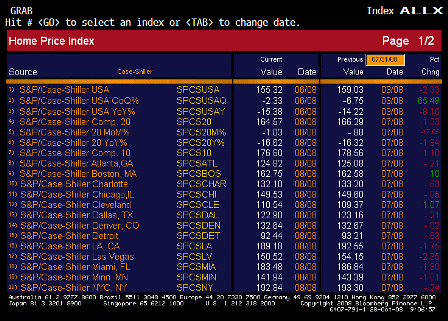
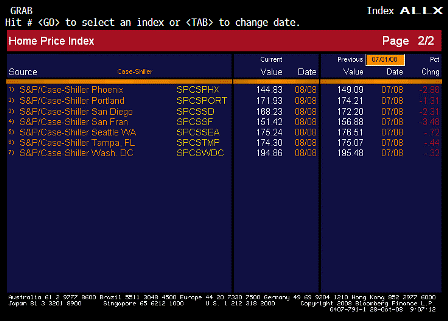
House Price Index MoM (Aug)
| Survey |
-0.5% |
| Actual |
-0.6% |
| Prior |
-0.6% |
| Revised |
-0.8% |
A little worse than expected and rates of decline may have leveled off.
[top][end]


House Price Index YoY (Aug)
| Survey |
n/a |
| Actual |
-5.9% |
| Prior |
-5.5% |
| Revised |
n/a |
Still falling but at perhaps moderating rates.
[top][end]


House Price Index ALLX (Aug)
[top]
Posted in Daily | No Comments »
Posted by WARREN MOSLER on 22nd October 2008
[Skip to the end]
This seems to be on the way back up:
(The ECB/BOE/SNB lent out $140.8 billion last night for 28-days at 2.11%)
Haven’t seen the Fed’s current total swap lines outstanding, which could be telling.
[top]
Posted in Fed | 7 Comments »
Posted by WARREN MOSLER on 22nd October 2008
[Skip to the end]
Europe adds to Bank Plans in Bid to Blunt Likely Recession
By David Gauthier-Villars and Leila Abboud in Paris, Sara Schaefer Munoz in London, and Mike Esterl in Frankfurt
Some European governments are looking at going beyond government aid to banks to help businesses, in an effort to inject money directly into the economy as lending remains stagnant and a continent-wide recession looms.
Italy’s government said Tuesday it was working on a package of economic-stimulus measures that could include guaranteeing corporate debt, a move that could give distressed Italian companies a new advantage over rivals elsewhere — and if enacted could set off a new round of cross-border competition, or complaints, about national aid.
Sounds highly inflationary, if the Italian guarantee is worth anything in the credit markets.
French President Nicolas Sarkozy called for the creation of sovereign-wealth funds to defend big companies from being bought up by non-Europeans at bargain prices, and proposed an “economic government” to coordinate euro-zone economic policy.
Also sounds highly inflationary as well as operationally problematic.
No talk of giving the euro parliament the fiscal authority to (deficit) spend their way out of the mess they have created.
[top]
Posted in Articles, Credit, EU | 2 Comments »
Posted by WARREN MOSLER on 22nd October 2008
[Skip to the end]
Here’s my proposal for banks that are presumably capital constrained:
Offer borrowers a package deal:
The borrower agrees to buy new bank VCP (variably convertible preferred) stock equal to, say, 10% of their proposed borrowings. This creates ‘balance sheet’ for the bank which then has the new ‘room’ to make the loan and then some. (Banks generally have 8% target capital ratios.)
The VCP functions as a ‘first loss piece’ for the bank as well.
Terms of the VCP might include an interest rate equal to the loan rate, and a variable conversion ratio designed to give the borrower all his funds back if he doesn’t default.
The VCP non-dilutive to the holders of common shares.
This VCP proposal can free up and create new balance sheet and raise capital as it services borrowing desires.
Feel free to forward this to everyone you know in banking.
[top]
Posted in Proposal | 4 Comments »
Posted by WARREN MOSLER on 22nd October 2008
[Skip to the end]
(email exchange)
And this only makes it worse:
By Balazs Penz and Zoltan Simon
Oct. 22- Hungary’s central bank raised its key interest rate in an emergency measure to shore up the country’s currency, after it fell to near a record against the euro.
The Magyar Nemzeti Bank in Budapest raised the two-week deposit rate today to 11.5 percent, the highest since July 2004, from 8.5 percent, it said in an e-mailed statement. The move came two days after the bank left rates unchanged at its regular meeting. The last emergency rate increase was in 2003.
Governments are net payers of interest, so raising rates adds to governments spending on interest and raises costs of doing business and costs of investments- all ‘inflationary biases’ that further weaken the currency.
And a weaker euro (just saw it at about 129) means unrealized dollar losses across the Eurozone grow as a percentage of (eurodenominated) capital, pushing the banking system and the national governments pledged to support it towards insolvency.
>
> On Wed, Oct 22, 2008 at 3:08 AM, wrote:
>
> I wonder whether this will prove a tipping point for the euro:
> The willingness of the ECB to “bail out” a country that is not
> yet member of the Eurozone is quite significant and signals the
> concerns that EMU members now have about the disruptive
> effects of a crisis in Hungary. Of course, they can do it now
> that the have the sub-underwriter of last resort in the Fed.
> Also, the ECB liquidity support, unlike IMF conditionality loans,
> does not come with any attached string. The additional issues
> that the ECB action has caused are however important: if 5
> billion is not enough if the financial pressures intensify would
> the ECB lend more? Will the ECB do similar swaps with other
> Emerging Europe economies that are likely candidates – in the
> next few year – for EMU membership? Also should Hungary now
> use this additional international liquidity to prevent a further
> depreciation of its currency or should it save this additional
> ammunition in case things get worse?
>
[top]
Posted in EU, Interest Rates | No Comments »
Posted by WARREN MOSLER on 22nd October 2008
[Skip to the end]


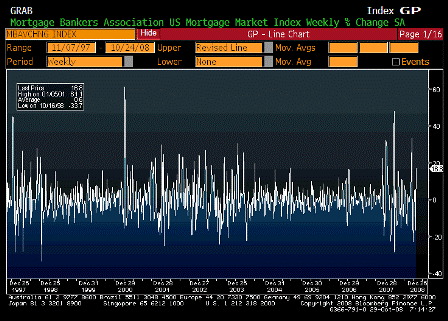
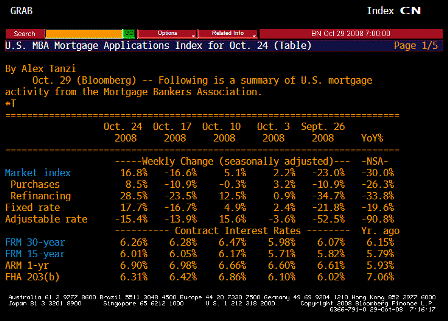
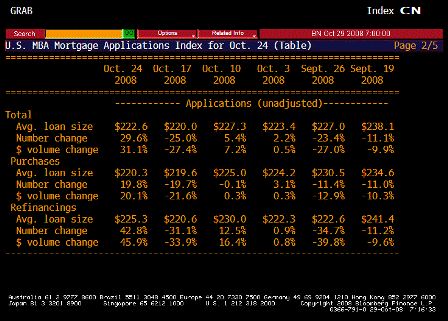
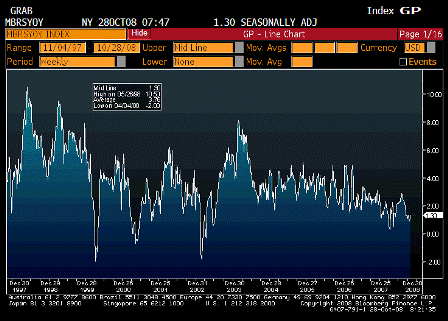
MBA Mortgage Applications (Oct 17)
| Survey |
n/a |
| Actual |
-16.6% |
| Prior |
5.1% |
| Revised |
n/a |
[top][end]


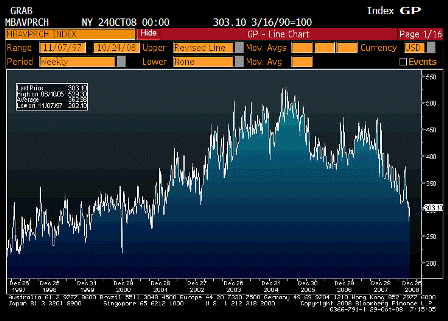
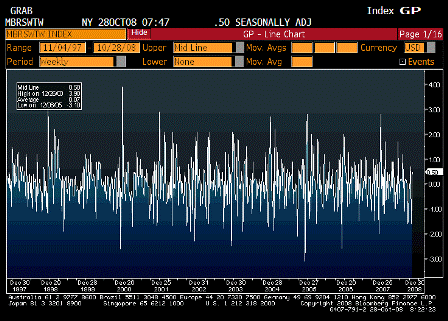
MBA Purchasing Applications (Oct 17)
| Survey |
n/a |
| Actual |
279.30 |
| Prior |
313.50 |
| Revised |
n/a |
Looks like a cycle low, as scared consumers dig in.
[top][end]


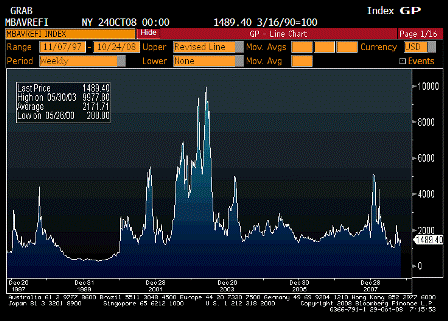
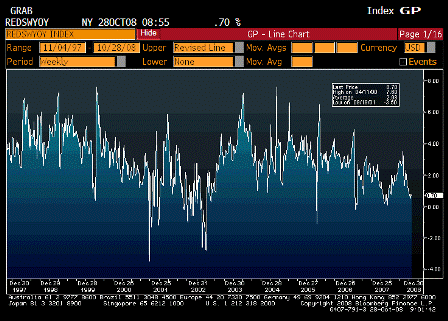
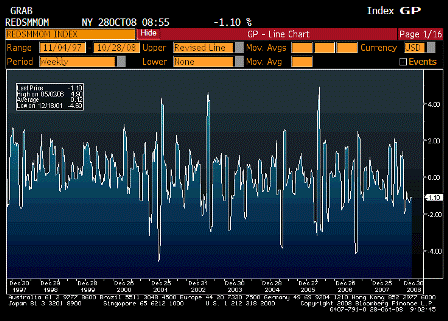
MBA Refinancing Applications (Oct 17)
| Survey |
n/a |
| Actual |
1158.80 |
| Prior |
1514.20 |
| Revised |
n/a |
[top][end]


MBA TABLE 1 (Oct 17)
[top][end]


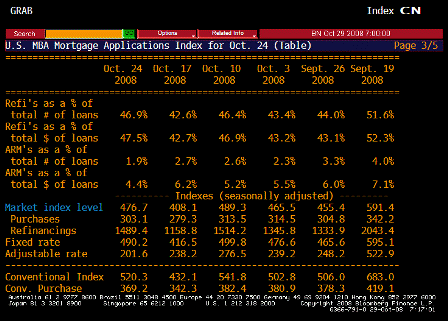
MBA TABLE 2 (Oct 17)
[top][end]


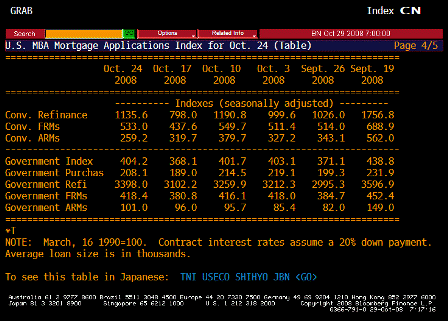
MBA TABLE 3 (Oct 17)
[top][end]


MBA TABLE 4 (Oct 17)
[top]
Posted in Daily | No Comments »